




















Montessori Furniture Wholesale Guide for Retailers & Distributors
Learn essential Montessori furniture wholesale strategies for B2B buyers. Master product selection, safety standards, materials, and landed cost calculation.
The global demand for montessori furniture wholesale guidechildren’s furniture continues to create opportunities for retailers, distributors, importers, and private-label brands.
But successful Montessori furniture wholesale sourcing involves much more than finding attractive products at a low factory price.
B2B buyers need to consider product selection, materials, safety requirements, MOQ, customization, packaging, shipping efficiency, supplier reliability, and—most importantly—whether the products are suitable for their target customers.
Thismontessori furniture wholesale guide explains how retailers and distributors can build a practical Montessori furniture collection and choose the right manufacturing partner for long-term growth.
1. Understand Your Target Market Before Choosing Products
One of the most common sourcing mistakes is selecting products before defining the customer.
A retailer selling directly to parents has different requirements from a distributor supplying daycare centers or children’s furniture stores.
Before requesting a quotation, define:
- Target country
- Customer age group
- Retail or commercial use
- Expected retail price range
- Online or offline sales channels
- Preferred materials
- Product positioning
- Required safety or compliance documentation
For example, an online retailer may prioritize compact flat-pack products with lower shipping volume, while a preschool furniture distributor may focus more heavily on durability, stability, and repeat bulk supply.
Start with the market, then build the product collection around it.
2. Choose the Right Montessori Furniture Categories
A strong wholesale collection does not necessarily need dozens of products.
For new retailers and distributors, a focused selection of complementary products can be easier to market and manage.
Popular categories may include:
室内攀爬架
Wooden indoor climbing frames encourage active play and can become a core product category for Montessori-inspired children’s brands.
Different configurations may include:
- Single climbing frames
- Climbing frames with slides
- Climbing frames with ramps
- Multi-frame climbing gyms
- Swing combinations
- Rope ladders
- Hammock combinations
- Activity platforms
Montessori Learning Towers
Learning towers are designed to help children participate in suitable everyday activities at an elevated working height under adult supervision.
For retailers, they can complement climbing products while reaching a different customer need.
Wooden Tables and Chairs
Children’s tables and chairs can be sold individually or as coordinated sets for:
- Playrooms
- Bedrooms
- 日托中心
- Preschools
- Activity areas
Bookshelves and Storage Furniture
Low-level bookshelves and storage units are another useful category for building a broader children’s furniture collection.
Activity and Play Furniture
Retailers can also consider arches, balance equipment, activity structures, and other wooden indoor play products depending on their target market.
The goal is not simply to carry more SKUs.
The goal is to create a collection in which products naturally support cross-selling.
3. Build a Good-Better-Best Product Structure
One useful wholesale strategy is to organize products into different price and feature levels.
For example:
Entry Level
A simple climbing frame or compact learning tower at an accessible price.
Mid-Range
A climbing frame combined with a slide, ramp, swing, or additional activity accessory.
Premium
A larger multi-functional indoor play gym with several activities and accessories.
This structure gives retailers more flexibility when serving customers with different budgets.
It also reduces dependence on one hero product.
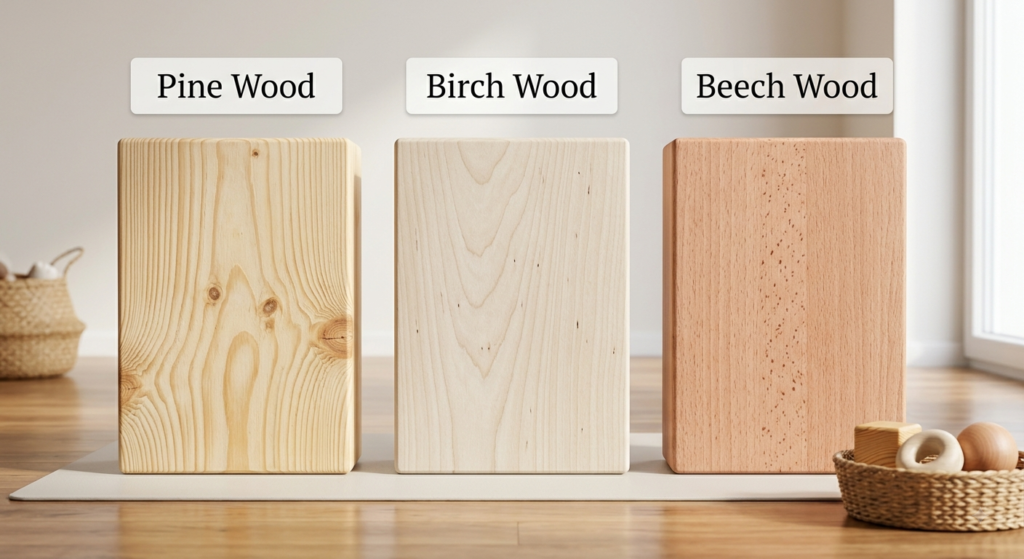
4. Evaluate Wood Materials Carefully
Material affects appearance, durability, weight, manufacturing cost, and retail positioning.
Common options include:
Pine
Solid pine offers a natural appearance and can provide a practical balance between performance and cost.
It is commonly used for wooden climbing structures and children’s furniture.
Beech
Beech is denser and can be suitable for buyers seeking a more premium material positioning or specific structural applications.
Birch Plywood
Quality birch plywood can work well for panels, platforms, ramps, seats, and other components requiring dimensional stability.
Rather than asking:
“Which wood is best?”
Ask:
“Which material is most suitable for this product, target price and intended use?”
A professional manufacturer should be able to explain the trade-offs.
5. Safety Compliance & Material Testing
Safety parameters are non-negotiable when importing children’s furniture. B2B buyers must verify that physical designs and coatings adhere to destination market standards:
- North America: Compliance with Consumer Product Safety Commission (CPSC) rules, ASTM F963 mechanical safety, and CPSIA total lead limits ($<90\text{ ppm}$).
- European Union: Compliance with Toy Safety Directive 2009/48/EC, EN71-1 (physical/mechanical), EN71-2 (flammability), and EN71-3 (heavy metal migration).
Important: Never assume a factory’s generic test report covers every model in their catalog. Request model-specific lab testing certificates before placing bulk orders.matically applies to every model in a supplier’s catalog.
6. Understand MOQ Before Building Your Collection
MOQ is one of the most important considerations for wholesale buyers.
However, there may be several different MOQs.
A manufacturer might have:
Standard Product MOQ
For existing models with standard specifications.
Color Customization MOQ
For custom painted or finished products.
Logo MOQ
For private-label branding.
Packaging MOQ
For fully customized retail cartons.
New Product Development MOQ
For completely customized structures or designs.
When requesting a quotation, specify exactly what you want customized.
This helps avoid comparing quotations that are based on different requirements.
7. Start With a Focused SKU Strategy
New retailers often make one of two mistakes:
They order too many different products, or they order too much inventory of one product.
A more balanced approach is to create a small test collection.
For example:
Core Product: Indoor climbing frame
Upgrade: Climbing frame + slide
Premium Option: Multi-functional climbing set
Complementary Product: Learning tower
Add-On: Swing, ramp or climbing accessory
This allows buyers to test different price points without creating an unnecessarily complicated inventory structure.
Once sales data becomes available, future orders can be adjusted toward the strongest-performing SKUs.
8. Consider OEM & Private Label Opportunities
Wholesale buyers do not always need to develop completely new products.
Sometimes relatively simple customization can create a distinctive collection.
Options may include:
- Custom logo
- Laser engraving
- 自定义颜色
- 定制包装
- Instruction manuals
- Product labels
- Carton marks
- Accessory combinations
- Product dimensions
- Selected structural modifications
This is especially useful for retailers building a recognizable private-label brand.
For more advanced projects, OEM and ODM development can support custom structures or complete product collections.
9. Evaluate Packaging as Part of the Product
For e-commerce retailers, packaging is not just a logistics issue.
It is part of the customer experience.
Before ordering, confirm:
- Carton dimensions
- Product dimensions
- Gross weight
- Net weight
- CBM
- Internal protection
- Hardware organization
- Assembly instructions
- Retail packaging requirements
- Shipping marks
Flat-pack design can be particularly valuable because transportation volume can have a significant impact on landed cost.
A slightly more expensive product with optimized packaging may ultimately be more economical than a cheaper product with inefficient carton dimensions.
10. Calculate Landed Cost, Not Only Factory Price
The EXW or FOB quotation is only part of the actual cost of importing Montessori furniture.
Retailers should consider:
Factory Price + Packaging + Inland Logistics + International Freight + Insurance + Duties/Taxes + Customs Clearance + Local Delivery
For e-commerce businesses, additional costs may include:
- Warehousing
- Fulfillment
- Last-mile delivery
- Returns
- Replacement parts
- Customer service
This is why wholesale purchasing decisions should be based on landed cost and expected margin, not factory price alone.
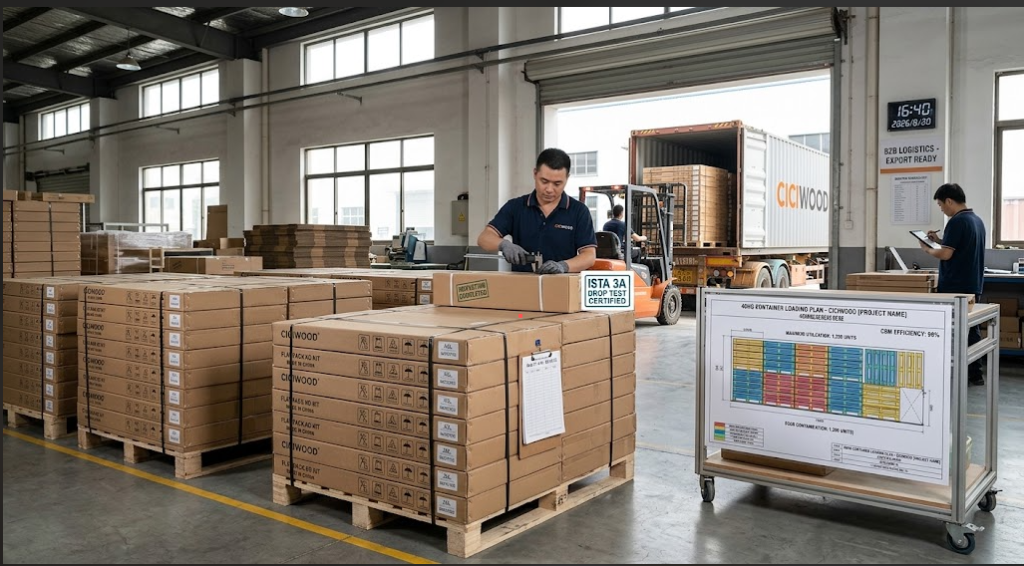
11. Think About Container Loading Efficiency
Wooden furniture can occupy significant shipping volume.
CBM therefore becomes an important purchasing metric.
When comparing products, ask the manufacturer for:
- Individual carton CBM
- Units per carton
- Estimated 20GP loading quantity
- Estimated 40GP loading quantity
- Estimated 40HQ loading quantity
For mixed-product orders, request a preliminary container-loading plan.
This can help distributors balance SKU variety with transportation efficiency.
12. Check Production Capacity Before Scaling
Retailers may begin with a relatively small trial order, but successful products can grow quickly.
Before building a long-term relationship, ask:
- 贵公司的月生产能力是多少?
- What is the normal production lead time?
- What happens during peak season?
- Can you support repeat orders?
- Can production scale with our sales?
- How do you manage quality during larger production runs?
A supplier should not only be able to produce your first order.
They should be able to support the next stage of your business.
13. Inspect Samples Before Placing Bulk Orders
Photos and videos are useful, but they cannot replace physical product evaluation.
Before placing a significant order, inspect a sample whenever practical.
Check:
- Wood quality
- Surface smoothness
- Color consistency
- Product dimensions
- Stability
- Hardware
- Accessories
- Assembly experience
- 包装
- Instructions
Assemble the sample using only the instructions included in the package.
This helps you experience the product from your customer’s perspective.
14. Quality Control Matters More as Order Volume Grows
A few minor inconsistencies can become a major problem when multiplied across hundreds or thousands of units.
Ask suppliers how they control quality during:
Raw Material → Cutting → Drilling → Sanding → Finishing → Assembly Inspection → Final QC → Packaging
For bulk orders, retailers may also consider conducting pre-shipment inspections.
Quality consistency is particularly important for private-label brands because customers associate manufacturing defects with the brand—not the factory.
15. Choose a Supplier for Long-Term Cooperation
Price matters, but successful wholesale relationships depend on more than price.
Evaluate potential suppliers based on:
| Area | What B2B Buyers Should Evaluate |
|---|---|
| Manufacturing | Real factory and production capabilities |
| 产品系列 | Ability to support your collection |
| 材料 | Appropriate material options |
| 质量 | Consistent workmanship and QC |
| Compliance | Support for applicable market requirements |
| MOQ | Suitable for your purchasing stage |
| OEM/ODM | Branding and customization capability |
| 包装 | Export and e-commerce readiness |
| Capacity | Ability to support growth |
| Communication | Accurate and responsive |
| Lead Time | Reliable production planning |
| After-Sales | Replacement and issue handling |
A strong manufacturing partner should help reduce sourcing complexity as your business grows.
16. Questions to Ask a Montessori Furniture Manufacturer
Before selecting a wholesale supplier, consider asking:
- Are you a manufacturer or trading company?
- How long have you produced children’s wooden furniture?
- Which markets do you export to?
- Which wood materials are available?
- What is your MOQ?
- Can different products be combined in one order?
- Do you support OEM and ODM?
- Can you customize colors and logos?
- Can you provide private-label packaging?
- What is your normal production lead time?
- What quality-control procedures do you use?
- What testing documentation is available for the product?
- What are the carton dimensions and CBM?
- How many units fit in a 40HQ container?
- Can you provide samples before mass production?
These questions can quickly reveal whether a supplier understands professional B2B purchasing requirements.
17. A Practical Wholesale Purchasing Process
A typical sourcing process can follow this sequence:
Market Research
↓
Product Selection
↓
Supplier Evaluation
↓
Quotation & MOQ Comparison
↓
Sample Order
↓
Product & Packaging Confirmation
↓
Compliance Review
↓
Trial Order
↓
Pre-Shipment Quality Inspection
↓
Shipping
↓
Sales Data Review
↓
Repeat Order & Collection Expansion
Following a structured process can reduce risk and make supplier comparisons more objective.
Final Thoughts
Successful Montessori furniture wholesale sourcing requires more than choosing attractive wooden products.
Retailers and distributors should think about the entire business model:
Product → Customer → Material → Safety → MOQ → Branding → Packaging → Logistics → Margin → Supplier
For new buyers, starting with a focused collection and testing the market can often be more effective than immediately purchasing a large number of SKUs.
For established distributors, supplier production capacity, quality consistency, customization capabilities, and logistics efficiency become increasingly important as order volume grows.
The objective is not simply to find the lowest-priced supplier.
It is to build a product collection and supply chain that can support sustainable long-term growth.
Looking for a Montessori Furniture Wholesale Manufacturer?
CiciWood supplies wooden children’s furniture and indoor play products for international B2B buyers.
Our product categories include wooden climbing frames, learning towers, children’s tables and chairs, storage furniture, and other Montessori-inspired wooden products.
We support:
- Wholesale and bulk orders
- OEM & ODM development
- Private-label branding
- 自定义颜色
- Custom product configurations
- 定制包装
- Export packaging
- Product development
- International shipping support
If you are a retailer, distributor, importer or private-label brand, send us your target products, estimated quantity, destination market and customization requirements to discuss your project.
Contact CiciWood for a wholesale quotation and OEM/ODM consultation.