




















How to Find a Reliable Wooden Kids Furniture Manufacturer in China: A B2B Buyer’s Guide
Looking for a reliable wooden kids furniture manufacturer in China? Learn how to evaluate wooden kids furniture manufacturer China, materials, safety, MOQ, OEM capabilities, QC and packaging.
Finding the right wooden kids furniture manufacturer in China can have a major impact on your product quality, delivery schedule, brand reputation, and overall purchasing costs.
For importers, wholesalers, distributors, retailers, and private-label brands, the challenge is not simply finding a factory that can produce wooden children’s furniture. The real challenge is identifying a supplier that can consistently deliver the right quality, support customization, understand your target market, and manage bulk production reliably.
Whether you are sourcing Montessori furniture, indoor climbing frames, learning towers, wooden tables and chairs, bookshelves, or other children’s wooden products, this guide explains what B2B buyers should evaluate before placing an order with a Chinese manufacturer.
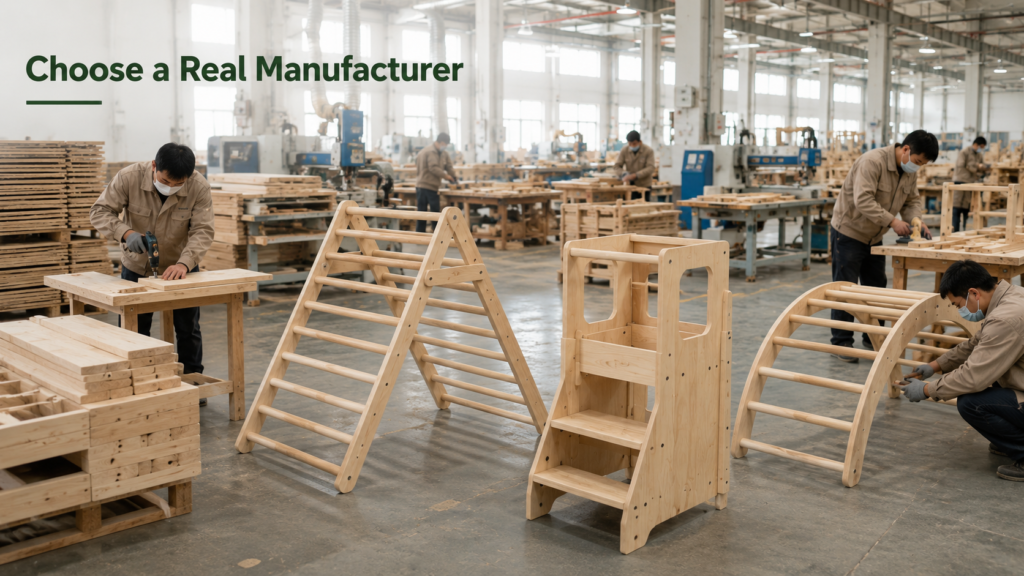
1. Manufacturer or Trading Company: Know Who You Are Buying From
One of the first questions to ask a potential supplier is:
Are you a manufacturer or a trading company?
Both can serve international buyers, but working directly with a manufacturer can provide important advantages when customization and long-term purchasing are involved.
A direct manufacturer may offer:
- Better control over production
- Faster communication about technical changes
- More flexible OEM and ODM options
- Easier sample modification
- Better visibility into quality-control procedures
- More competitive pricing for larger orders
- Greater control over lead times
Before making a decision, ask the supplier to provide factory photos, production videos, workshop information, machinery details, production capacity, and quality-control procedures.
For larger projects, a video factory tour or third-party factory audit can provide additional verification.
2. Check the Manufacturer’s Experience With Children’s Products
Manufacturing ordinary wooden furniture and manufacturing furniture designed for children are not exactly the same.
Children’s products require greater attention to details such as:
- Rounded corners
- พื้นผิวเรียบ
- โครงสร้างที่มั่นคง
- Appropriate spacing
- Secure hardware
- Surface coatings
- Load-bearing performance
- Small components
- Product instructions
- Age-appropriate design
A supplier experienced in children’s furniture should understand these requirements from the product-development stage rather than treating them as changes made only after production.
Ask potential suppliers:
How many years have you produced children’s wooden furniture?
Which children’s product categories do you specialize in?
Which export markets do you currently serve?
Can you provide examples of similar products you have manufactured?
Relevant manufacturing experience can significantly reduce communication problems during product development.
3. Evaluate Material Quality
Material selection affects durability, appearance, production cost, packaging weight, and customer experience.
Common materials for wooden children’s furniture include:
ไม้สน
Pine is widely used for children’s furniture because it offers a good balance between natural appearance, weight, workability, and cost.
It can be particularly suitable for climbing frames, learning towers, tables, chairs, and other indoor furniture.
ไม้บีช
Beech is generally denser and harder than pine. It is often selected for products where buyers want a more premium feel or stronger structural components.
ไม้อัดเบิร์ช
High-quality birch plywood can provide good dimensional stability and is commonly used for panels, platforms, ramps, and other components.
The best material is not necessarily the most expensive material.
The correct choice depends on:
- โครงสร้างผลิตภัณฑ์
- Target retail price
- Intended use
- Required load capacity
- Target market
- Packaging requirements
- Brand positioning
A reliable supplier should be able to explain why a particular material is appropriate instead of simply recommending the cheapest option.
4. Pay Attention to Surface Finishing
For children’s wooden furniture, surface finishing is one of the easiest areas for buyers to evaluate during sampling.
Check whether:
- Surfaces feel smooth
- Edges are properly rounded
- Holes are cleanly drilled
- There are visible splinters
- Paint or coating is consistent
- Components fit correctly
- Wood surfaces have obvious cracks
- Fasteners are properly positioned
Hand sanding and multiple-stage sanding can improve the final touch and reduce rough edges.
When receiving samples, inspect areas children are most likely to touch, including ladder rungs, handles, platform edges, slide edges, openings, and corners.
5. Verify Safety and Compliance for Your Target Market
Compliance requirements vary depending on the product category and destination market.
This is an area where B2B buyers should avoid assumptions.
Instead of asking only:
“Do you have certificates?”
Ask:
“Which standards has this exact product or product family been tested against?”
Depending on the product and market, buyers may need to investigate requirements or standards associated with:
- ASTM
- CPSIA
- CPC documentation
- EN 71
- CE-related requirements where applicable
- FSC-certified material sourcing
Importantly, one certificate should not automatically be assumed to cover every product a factory manufactures.
Ask for the relevant test report and check:
- Product name
- Model number
- Testing laboratory
- Test standard
- Report date
- Tested materials
- Applicable product configuration
If you are developing a substantially different OEM product, additional testing may be necessary.
6. Evaluate the Factory’s Quality-Control System
A reliable manufacturer should not rely only on final inspection.
Quality control should happen throughout production.
A typical process may include:
Raw Material Inspection → Cutting → Drilling → Sanding → Surface Finishing → Assembly Check → Final Inspection → Packaging
For wooden kids furniture, buyers can ask the factory to check:
- Wood moisture and condition
- Component dimensions
- Hole positions
- Surface smoothness
- Color consistency
- Hardware completeness
- Assembly accuracy
- Structural stability
- Packaging completeness
For larger orders, consider requesting a pre-shipment inspection before the remaining balance is paid.
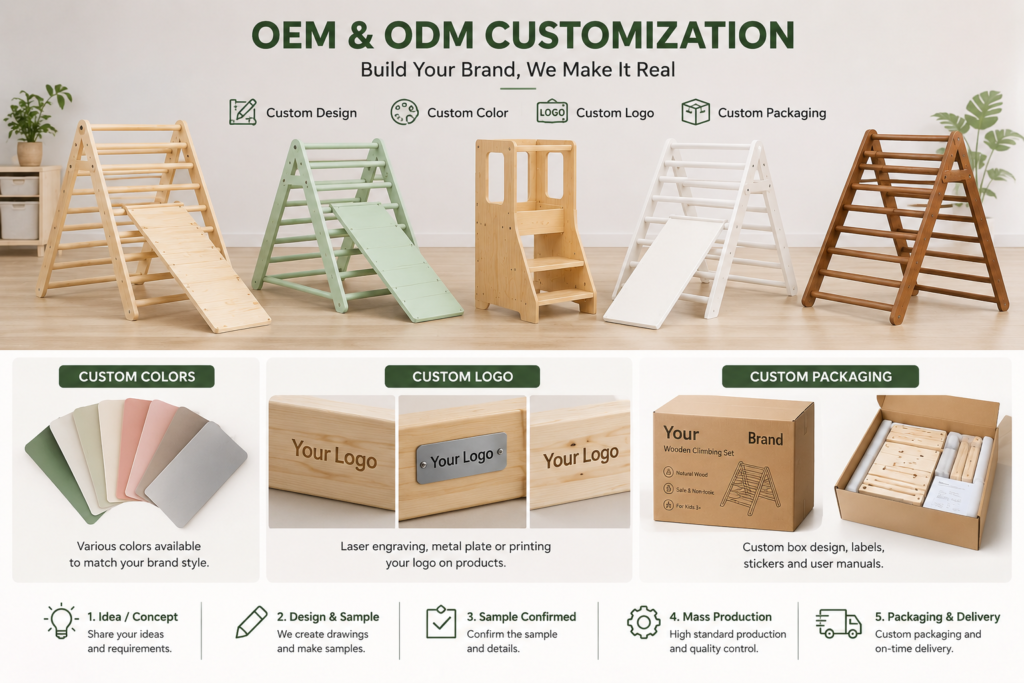
7. Ask About OEM and ODM Capabilities
If you are building your own brand, manufacturing flexibility becomes extremely important.
A capable OEM wooden kids furniture manufacturer may help customize:
- Product dimensions
- Wood species
- Colors
- Product configuration
- Accessories
- Logo
- บรรจุภัณฑ์
- Instruction manuals
- Carton marks
- Product labels
ODM services can go further by helping transform a concept or reference idea into a manufacturable product.
Before starting customization, confirm:
- Development cost
- Sample cost
- Sample lead time
- Production MOQ
- Tooling requirements
- Packaging requirements
- Testing requirements
- Intellectual-property responsibilities
Clear communication at the beginning can prevent expensive changes later.
8. Understand MOQ Before Requesting a Quote
MOQ — Minimum Order Quantity — is especially important for new brands and distributors testing a market.
MOQ can depend on:
- โครงสร้างผลิตภัณฑ์
- วัสดุ
- Color
- Customized packaging
- Logo requirements
- Hardware
- Production process
- Order value
Instead of asking only:
“What is your MOQ?”
A better question is:
“What is the MOQ for the standard version, and what is the MOQ if we customize the logo, color, and packaging?”
This gives you a much more realistic understanding of the project.
Some manufacturers may also allow buyers to combine several models within a larger order, depending on production requirements.
9. Compare Total Cost, Not Just Unit Price
The cheapest quotation is not always the lowest-cost purchasing option.
Suppose Supplier A offers a lower unit price but has:
- Higher defect rates
- Poor packaging
- Longer lead times
- Inconsistent colors
- Missing hardware
- Limited after-sales support
Supplier B may quote slightly higher but provide better consistency.
For a B2B buyer, the true purchasing cost should include:
Product Cost + Packaging + Quality Risk + Shipping + Import Costs + After-Sales Cost
A small difference in factory price can become insignificant compared with the cost of damaged shipments or customer returns.
10. Check Packaging Before Mass Production
Wooden furniture can be bulky, which makes packaging particularly important for international trade.
Good packaging should protect:
- Corners
- Panels
- Painted surfaces
- Hardware
- Accessories
- Wooden components
For flat-pack children’s furniture, buyers should also confirm:
- Carton dimensions
- Gross weight
- Net weight
- CBM
- Internal protection
- Hardware packaging
- Assembly instructions
- Shipping marks
Ask the manufacturer for a complete packaging photo or packaging sample before approving mass production.
Packaging optimization can also help improve container utilization and reduce logistics costs.
11. Ask About Production Capacity and Lead Time
A supplier may produce excellent samples but still struggle with large orders.
Ask about:
- Monthly production capacity
- Number of production lines
- Peak-season capacity
- Normal lead time
- Raw-material preparation time
- OEM development time
- Quality-inspection time
If you expect your business to grow, choose a supplier capable of scaling with you.
A manufacturer that works well for a 100-piece trial order may not necessarily be able to support several containers per month.
12. Evaluate Communication Speed and Professionalism
Supplier communication is often underestimated.
Before placing an order, observe:
- How quickly questions are answered
- Whether answers are specific
- Whether specifications are confirmed in writing
- Whether the supplier identifies potential problems
- Whether documents are organized
- Whether changes are recorded correctly
Good manufacturers do more than say “yes.”
Sometimes the most valuable response from a supplier is:
“This design may create a production or safety problem. We recommend changing this part.”
That demonstrates manufacturing experience rather than simple order-taking.
13. Always Start With a Sample
For new suppliers, avoid evaluating quality only from online photos.
Order a sample whenever practical.
During sample evaluation, check:
- Overall dimensions
- Wood quality
- Surface finish
- Stability
- Hardware
- Assembly
- Accessories
- บรรจุภัณฑ์
- Instructions
- Color accuracy
If possible, assemble the product exactly as your customer would.
This can reveal problems that may not be visible when inspecting individual components.
14. Conduct a Trial Order Before Scaling
After sample approval, a trial order can help evaluate the manufacturer’s real production capabilities.
The goal is not only to inspect the product.
You are also testing:
- Communication
- Production management
- Quality consistency
- บรรจุภัณฑ์
- Lead time
- เอกสาร
- Shipping coordination
If the trial order performs well, you can gradually increase purchasing volume.
15. Red Flags When Choosing a Wooden Kids Furniture Supplier
Be cautious if a supplier:
- Cannot clearly explain where products are manufactured
- Avoids showing production facilities
- Provides incomplete test documentation
- Gives extremely low prices without explaining specifications
- Frequently changes quotations
- Cannot confirm materials
- Provides inconsistent product specifications
- Refuses sample inspection
- Has unclear QC procedures
- Cannot explain packaging details
One warning sign does not automatically mean a supplier is unreliable, but several warning signs together should trigger additional verification.
B2B Supplier Evaluation Checklist
Before selecting a manufacturer, evaluate these ten areas:
| Factor | What to Check |
|---|---|
| Factory | Real manufacturing capability |
| Experience | Children’s furniture specialization |
| วัสดุ | Pine, beech, birch plywood, etc. |
| ความปลอดภัย | Applicable testing and documentation |
| QC | Production and final inspection |
| OEM/ODM | Customization capabilities |
| MOQ | Standard and customized MOQ |
| Capacity | Ability to support future growth |
| บรรจุภัณฑ์ | Export-ready packaging |
| Communication | Professional and consistent response |
Do not select a manufacturer based on only one factor.
The best supplier should provide a balance of quality, compliance support, manufacturing capability, price, communication, and reliability.
Why Many B2B Buyers Source Wooden Kids Furniture from China
China has developed a mature furniture manufacturing supply chain that can support everything from raw materials and woodworking to hardware, packaging, product testing, and international logistics.
For international buyers, this can make it possible to source multiple categories from one manufacturing ecosystem, including:
- เครื่องเล่นปีนป่ายในร่ม
- Montessori learning towers
- Wooden tables and chairs
- Bookshelves
- เฟอร์นิเจอร์แบบปรับได้
- Indoor playground equipment
- Customized wooden children’s furniture
However, sourcing successfully requires more than finding a supplier online.
The key is establishing a repeatable supplier-verification process.
Final Thoughts
Finding a reliable wooden kids furniture manufacturer in China requires more than comparing quotations.
A professional B2B buyer should evaluate:
Factory Capability → Materials → Safety → Quality Control → Customization → MOQ → Packaging → Capacity → Communication → Samples
The right manufacturing partner can help you reduce sourcing risks, improve product consistency, and build a stronger children’s furniture brand over the long term.
Looking for a Wooden Kids Furniture Manufacturing Partner?
CiciWood specializes in wooden children’s furniture and indoor play products for international B2B buyers.
We support wholesalers, distributors, retailers, and private-label brands with:
- OEM & ODM customization
- Custom colors and configurations
- Private-label branding
- บรรจุภัณฑ์ตามสั่ง
- Bulk production
- Export packaging
- Product development support
- International B2B orders
If you are developing a new children’s furniture collection or looking for a long-term manufacturing partner in China, send us your product list, target quantity, destination market, and customization requirements.
Contact CiciWood for a wholesale quotation or OEM/ODM discussion.