




Precision Machining: 4 Key Details for Wooden Climbing Frames in 2026
A wooden climbing frame depends on accurately made components for smooth assembly. Every drilled hole has a purpose, helping side panels, climbing rungs, and fasteners fit together as designed. Consistent hole sizes, spacing, and positioning contribute to wooden climbing frame quality and reduce unnecessary adjustments during installation.
A wooden climbing frame begins its life as a scattered collection of separate components. Side panels, climbing rungs, support beams, and fastening hardware must eventually come together to form a cohesive, safe structure according to a highly specific design. While end consumers naturally focus on the finished silhouette or the vibrant colors first, the absolute accuracy achieved through precision machining plays a critical, behind-the-scenes role in how those individual components fit together.
At Ciciwood, we place immense value on the production nuances that guarantee a smoother, frustration-free assembly experience. The precise diameter, spacing, depth, and spatial positioning of each opening all deserve meticulous attention. A neat-looking hole is only a fraction of the picture: it must perfectly match its intended counterpart and connection point. Explore our wholesale wooden climbing frames to see our craftsmanship.
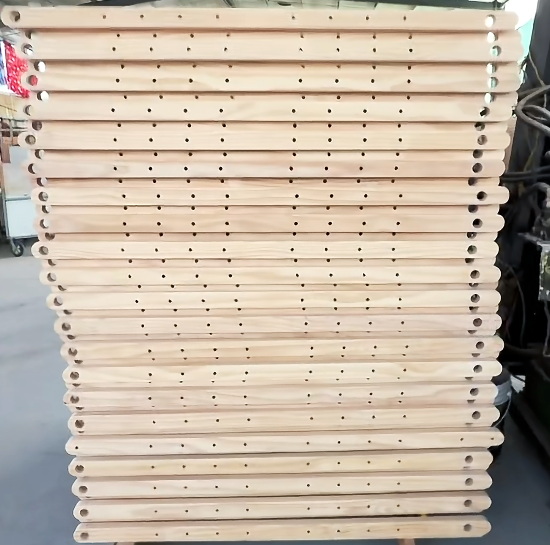
Every Hole Has a Purpose in Precision Machining
The openings in a wooden climbing frame are far more than just repeated decorative features. Each one serves a highly particular mechanical function within the product’s overarching structure. Some are designed to accommodate screws, bolts, or barrel nuts, while others are precisely sized to receive wooden rungs or other dynamic connecting parts.
This means that achieving high-level accuracy does not require every single hole on the product to share the exact same diameter. Different types of connections demand different dimensions. What truly matters is that openings intended for the same purpose strictly follow the identical specification, and that each cut perfectly matches the relevant technical drawing and hardware requirements.
Understanding these subtle differences helps buyers and QA teams assess production photos much more accurately. Consistency should be judged between matching, corresponding features, rather than across every visible opening on the panel.
Accurate Positioning is the Foundation of Precision Machining
Before the drill bit ever touches the timber, the workpiece needs to be positioned flawlessly. Its orientation, reference edges, and intended hole locations must be crystal clear to the operator. Pieces that look visually similar may still have vastly different machining requirements, particularly when they are mirror images belonging to opposite sides of the structure.

Consistent Diameters Guarantee a Proper Fit
A single positioning mistake can cascade and affect several later steps. A hole may look clean and perfectly circular to the naked eye, but still sit fractionally away from its required location.
When the corresponding part is added during assembly, that microscopic difference can make alignment incredibly difficult. Careful preparation—keeping the workpiece absolutely stable and utilizing consistent reference points—provides a sound starting point for repeatable, high-quality machining.
The diameter of an opening directly affects how a connection ultimately fits. An opening that is too small may prevent the intended part from entering correctly, leading to cracked wood or stripped hardware. Conversely, an opening that is too large may create unwanted movement, instability, or fail to provide the snug fit required by the structural design.
The appropriate dimensions depend entirely on the specific connection. A clearance hole for a heavy-duty bolt, for example, serves a completely different mechanical purpose from a hole designed to firmly grip a wooden rung. These features must be assessed against their own unique functional requirements. For buyers, the most useful question is not simply whether the openings look uniform, but whether the supplier can explain the intended fit and consistently verify that the finished components meet the agreed specification.
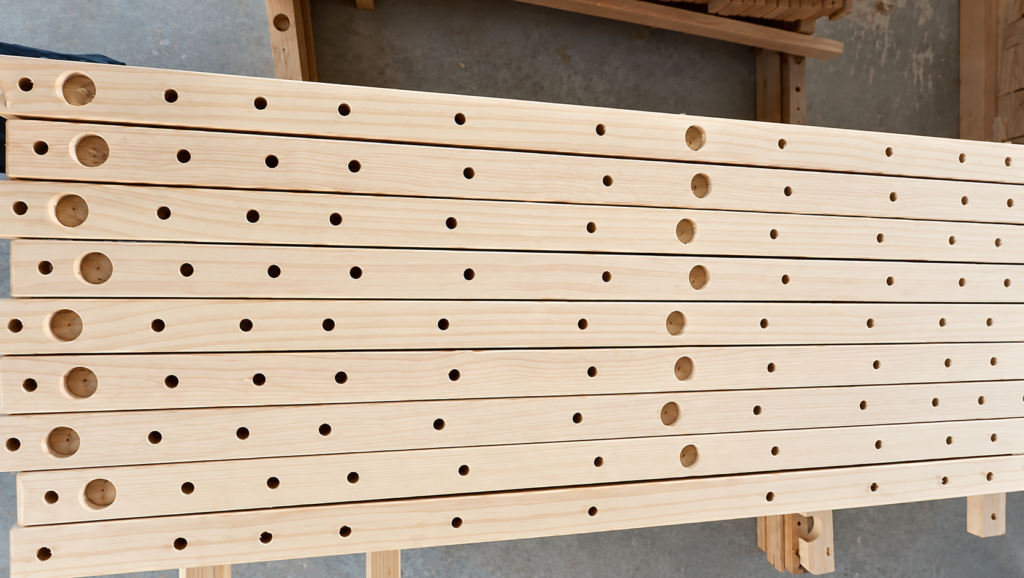
Spacing, Depth, and Angulation
Consistent spacing is absolutely critical where several connections must line up simultaneously. A series of climbing rungs, for instance, requires perfectly corresponding positions on both supporting components. If the spacing deviates even slightly between matching pieces, the final assembly may become awkward and unstable, even when the individual hole diameters are entirely correct.
Furthermore, accuracy involves far more than just the surface position. Depth and directional angulation also matter immensely, particularly for connections that do not pass all the way through the wood. A hole drilled at an unintended angle may severely affect the alignment of the part inserted into it, while an incorrect depth may prevent a component from seating flush as designed. These internal issues are not always obvious in a standard photograph taken from above. For this reason, a truly useful inspection must consider the complete, three-dimensional feature—surface appearance, internal dimensions, and the relationship to the matching component.
Clean Edges Reflect Careful Finishing
Following the drilling process, the edges around the openings should be meticulously checked for loose fibers, splintering, and visible damage. Wood is an organic, natural material, and its wood grain behavior can heavily influence how it responds to cutting tools.
Cleaning away wood chips makes the internal area much easier to inspect. Where subsequent finishing is needed, it should effectively remove roughness without unintentionally altering the critical dimensions of the connection. The ultimate aim is a clean, properly formed opening that remains perfectly consistent with the engineering design. Excessive sanding is never a substitute for initial accuracy, and an attractive surface finish should never be allowed to hide a poor structural fit.
Repeatability Matters Across the Entire Order
A single correctly machined component is a great starting point, but wholesale buyers also require absolute consistency throughout the entire order. Matching parts should be produced to the exact same agreed requirements so that the assembly experience does not vary unnecessarily from one set to another.
Achieving this repeatability depends on several crucial factors, including stable positioning, suitable tooling, and rigorous in-process checks during production. Changes in machine setup or tool wear can affect the finished result and must receive constant attention. For distributors and retailers, consistent, high-quality components can help make customer support and installation much more manageable. Clear specifications also provide a shared, objective reference point when discussing samples, production approval, or addressing questions raised after delivery.
Inspection and Trial Assembly Work in Tandem
Visual inspection can reveal obvious cosmetic defects, but it simply cannot confirm every aspect of a machined connection. Dimensional checks and physical trial assemblies provide the additional data needed to guarantee quality. Measurements can help confirm whether selected features meet the strict product requirements, while trial assembly can definitively show whether corresponding components align and whether the intended hardware fits perfectly.
If assembly proves difficult, the root cause should be thoroughly investigated before the connection is forced, which could cause permanent damage. The issue could involve positioning, dimensions, component orientation, or another part of the assembly sequence. Identifying the exact cause supports a much more useful correction than simply trying to tighten the hardware harder.
Machining Accuracy is Just One Part of Overall Quality
Clear specifications also provide a shared, objective reference point when discussing samples, production approval, or addressing questions raised after delivery. (Read more about our strict quality control process here.
Material selection, structural design, the quality of fasteners, surface finishing, clear assembly instructions, and appropriate product testing must also be carefully considered. Each element contributes to the finished product in a different way. Production photographs can help explain workmanship, but they should always be viewed alongside relevant technical specifications and supporting documentation. This gives buyers a clearer, more objective basis for evaluation than appearance alone.
Clear Communication Connects Buyers and Production
For an overseas buyer, detailed production images and videos can make technical discussions significantly easier. A close-up of a machined component may help explain a specific connection, highlight a potential question, or confirm which feature needs further attention.
At Ciciwood, we value direct, transparent communication with our manufacturing partners. Discussing component alignment, installation requirements, and finishing details helps translate customer expectations into highly practical production requirements. Clear communication also means being specific. Rather than simply asking for “better quality,” buyers and suppliers can discuss the exact feature, the required result, and exactly how it will be checked and verified.
A finished wooden climbing frame represents the culmination of many individual details. Precision machining is just one of those details, yet it is the vital link connecting the manufacturing process to the final user’s assembly experience. Giving each connection the meticulous attention it needs helps create a more consistent product and a much clearer purchasing process.
Contact Ciciwood to discuss wooden climbing frame styles, product specifications, and wholesale cooperation.