



















Navigating Wooden Children Furniture Safety Certification: A Complete B2B Compliance Guide for US & EU Markets
Learn essential wooden children furniture safety certification rules for US & EU markets. Master ASTM, CPSC, and EN71 compliance today.
For cross-border e-commerce brands, importers, and retail distributors, navigating international regulatory frameworks is one of the most complex operational challenges in the educational furniture sector. Bringing children’s products to market requires far more than aesthetic appeal; failure to meet mandatory wooden children furniture safety certification standards can lead to severe custom holds, Amazon listing removals, or costly product recalls.
This guide provides a comprehensive, non-commercial breakdown of the technical compliance benchmarks, chemical testing requirements, and lab documentation needed to successfully clear U.S. and European customs.
1. The U.S. Market Framework: CPSC, CPSIA, and ASTM Standards
In the United States, children’s products intended for ages 12 and under are strictly regulated by the Consumer Product Safety Commission (CPSC). To legally distribute wooden nursery or active play furniture, importers must ensure compliance with three core pillars:
A. ASTM F963 Physical & Mechanical Safety
Originally a toy standard, ASTM F963 mechanical guidelines apply to small active play equipment and toddler furniture elements. Key testing parameters include:
- Sharp Edge & Point Testing: All exposed timber edges must be radiused ($R \ge 3\text{mm}$) to eliminate sharp burrs or splinters.
- Small Parts Hazard: Components, removable pegs, or hardware must not fit inside the standard CPSC small parts cylinder to prevent choking hazards.
- Structural Stability & Anti-Tip: Furniture must pass weighted tilt testing to prevent tipping under dynamic load shifting.
B. CPSIA Lead & Phthalate Limits
The Consumer Product Safety Improvement Act (CPSIA) enforces strict chemical thresholds on surface coatings and substrates:
- Total Lead in Surface Coatings: Clear lacquers, paints, and organic stains must not exceed 90 ppm (0.009%).
- Lead in Substrates: Plywood cores and solid wood hardware must not exceed 100 ppm.
- Phthalates Restrictions: Soft plastics, rubber feet, or protective caps must contain less than 0.1% of regulated phthalate plasticizers.
2. The European Market Framework: CE Marking and EN71 Directives
To qualify for wooden children furniture safety certification in European markets, manufacturers must meet CE directives.
To place wooden children’s furniture on the market in the European Economic Area (EEA), products must bear the CE Mark, demonstrating compliance with Toy Safety Directive 2009/48/EC and relevant European Standards (EN).
         ┌────────────────────────────────────────────────────────┐
         │          European Safety Compliance Matrix             │
         └───────────────────────────┬────────────────────────────┘
                                     │
           ┌─────────────────────────┴─────────────────────────┐
           ▼                                                   ▼
┌─────────────────────┐                             ┌─────────────────────┐
│    EN 71-1 & 71-2   │                             │       EN 71-3       │
├─────────────────────┤                             ├─────────────────────┤
│ Physical, Mechanical│                             │ Migration of Heavy  │
│ & Flammability Risk │                             │ Metal Elements      │
└─────────────────────┘                             └─────────────────────┘
- EN 71-1 (Mechanical and Physical Properties): Focuses on structural integrity, entrapment hazards (ensuring gaps between rungs are not between 25mm and 60mm to prevent head/neck entrapment), and pinch points.
- EN 71-2 (Flammability): Tests the rate of flame spread across natural timber and surface coatings.
- EN 71-3 (Migration of Certain Elements): Regulates 19 heavy metal elements (including aluminum, antimony, arsenic, barium, cadmium, chromium, and organic tin) in scrapable toy materials.
3. Indoor Air Quality & Adhesive Emissions: CARB P2 vs. REACH Annex XVII
Chemical hazard testing is another essential component of wooden children furniture safety certification.
Beyond physical safety, modern educational markets demand rigorous transparency regarding indoor air quality and chemical off-gassing.
North America: EPA TSCA Title VI / CARB Phase 2
All composite wood materials (such as Baltic birch plywood or MDF panels) imported into the U.S. must be certified low-formaldehyde emitters. Formaldehyde emissions from plywood cores must test below 0.05 ppm under primary chamber test methods (ASTM E1333 or ASTM D6007).
Europe: REACH & SVHC Compliance
Under the EU’s Registration, Evaluation, Authorization and Restriction of Chemicals (REACH) regulation, products must not contain Substances of Very High Concern (SVHC) exceeding 0.1% weight by weight (w/w).
4. Mandatory Lab Documentation & Certification Checklist
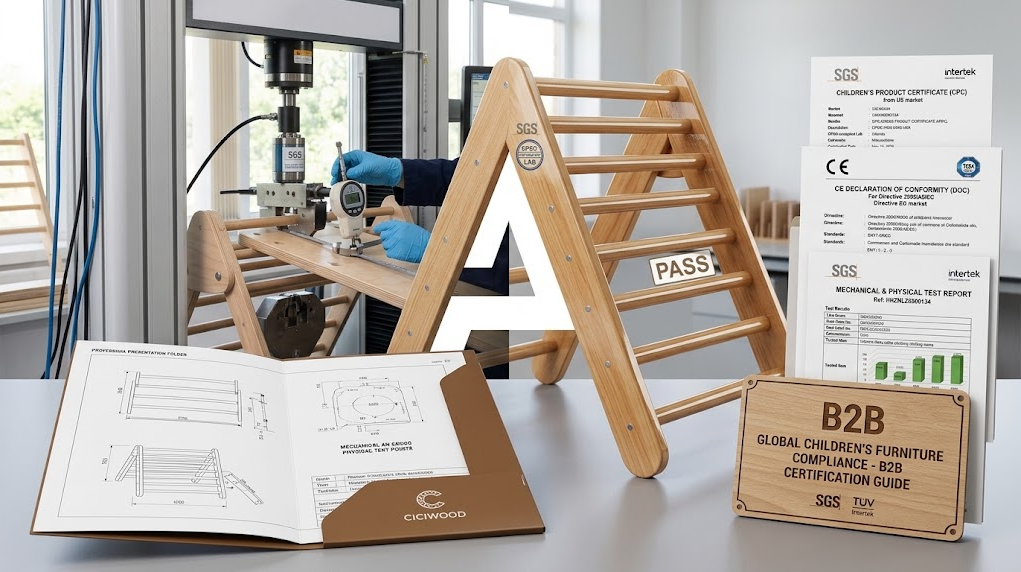
Obtaining a valid wooden children furniture safety certification requires partnering with ISO 17025 accredited third-party testing laboratories (such as SGS, TÜV Rheinland, Bureau Veritas, or Intertek).
Before placing an order or launching an e-commerce campaign, ensure your factory provides the following audit trail:
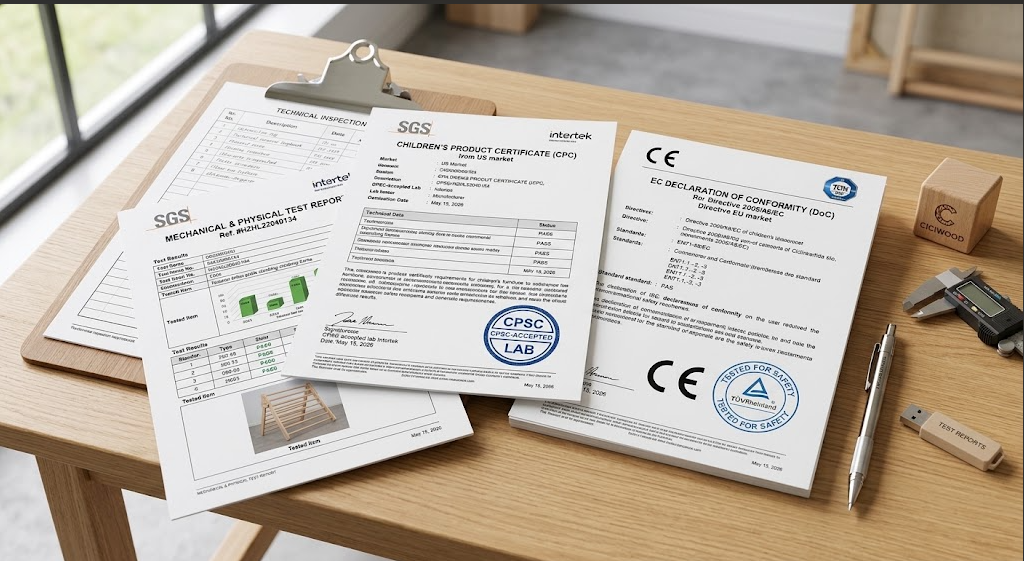
- Children’s Product Certificate (CPC): For the U.S. market, the importer of record must issue a formal CPC based on passing test reports from a CPSC-accepted laboratory.
- EC Declaration of Conformity (DoC): For the EU market, a signed legal document declaring that the product satisfies all applicable EN71 and REACH directives.
- Traceability Tracking Labels: Both US and EU laws require permanent tracking marks on the physical product and packaging (indicating manufacturer name, production location, batch number, and date code).
💡 Summary & Compliance Roadmap
Achieving full wooden children furniture safety certification is a non-negotiable prerequisite for long-term commercial success in North America and Europe. By establishing a clear compliance verification checklist—covering physical entrapment rules, heavy metal screening, and formaldehyde limits—importers and e-commerce brands can avoid custom delays, protect consumers, and build a trusted brand presence.
For additional compliance checklists, technical documentation templates, or regulatory guidance, explore our [Safety & Certification] knowledge base today.