




















Indoor Climbing Frame with Slide and Swing: One Play Set, More Ways to Move
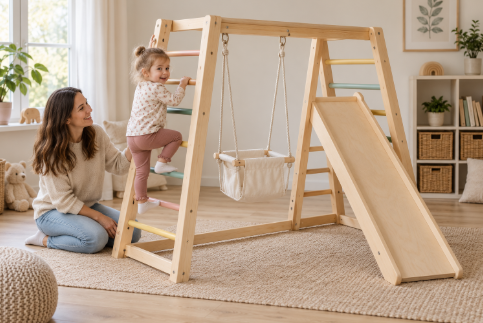
Natural wood indoor climbing frame with slide and swing in a neutral playroom while a parent supervises a child wearing socks.
Families often want children to move more indoors, but separate ladders, slides and swings can quickly crowd a room. An indoor climbing frame with slide and swing brings several movement choices into one coordinated footprint.
The value of this type of play set is not simply the number of accessories. A practical design gives every activity a clear role while keeping the structure stable, the play routes visible and the setup manageable for adults.
Children can climb for a few minutes, use the ramp for sliding or take a quiet break in the swing without bringing out different equipment each time.
For retailers and distributors, a multi-activity climbing frame also presents a clear product story. One hero model can demonstrate material quality, construction, color options and accessories while supporting entry-level and premium configurations within the wider collection.
Why One Integrated Play Set Works
A single structure creates variety without requiring every activity to happen at the same time.
Children can approach the frame in different ways while parents keep the main activity area in one part of the room. This makes setup, supervision and storage more practical than placing several unrelated products across the floor.
The integrated format also encourages repetition. A child may climb the same route several times, change to another rung, use the ramp as an incline or rest in the swing.
The structure remains familiar while the activity changes. This combination of familiarity and choice makes multi-function wooden play furniture suitable for family playrooms, children’s rooms, preschools and early-learning spaces.
What Each Feature Adds
The Climbing Frame
The climbing section forms the foundation of the complete set.
Well-spaced rungs provide visible hand and foot positions, while a rigid base helps the product remain stable during normal use. Rounded edges and a smooth finish are important because children’s hands, knees and feet repeatedly contact the same surfaces.
The exact rung spacing, product height, age grade, permitted user count and stated load conditions should always follow the instructions supplied with the individual model.
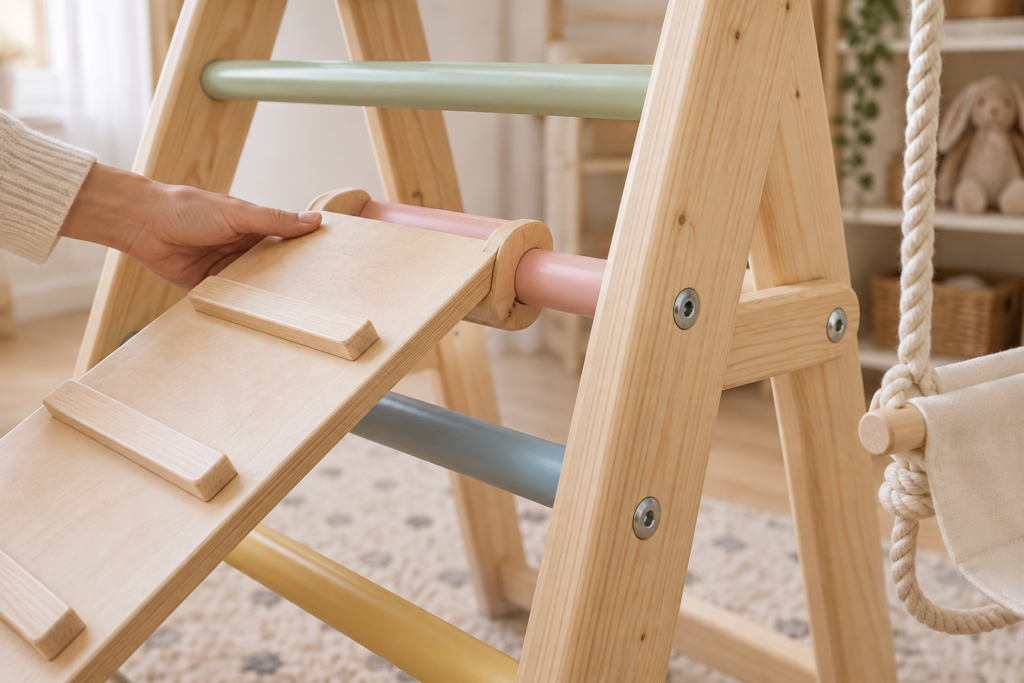
The Reversible Ramp and Slide
A reversible board can change the play experience without adding another large component.
One side may provide a smooth sliding surface, while the reverse side may include wooden steps or climbing holds. This allows the same accessory to support both sliding and climbing activities.
Buyers should confirm:
- How the ramp connects to the frame
- Which rungs are approved attachment points
- Whether different height settings are available
- Whether both sides are intended for use
- How the board should be stored when removed
The Swing
The swing introduces a quieter movement option and gives the structure another use between climbing sessions.
Its performance depends on secure suspension points, appropriate ropes or straps and enough surrounding clearance. A removable swing can also make cleaning, storage and replacement more convenient.
The seat design, suspension height and installation method should match the product’s stated age grade and instructions.
Plan the Room Before Choosing a Model
An indoor climbing frame may look compact in a photograph but still require more working space than expected.
The assembled dimensions describe the main frame. Families must also consider the space occupied by the ramp, the movement path of the swing and the area an adult needs for supervision.
Always measure the complete setup rather than the frame alone.
Before purchasing or listing a model, record its assembled length, width and height with every included accessory installed. Check the available ceiling height, doorways, radiators, windows, shelves and nearby furniture edges.
The final location should follow the manufacturer’s instructions for installation, flooring and surrounding clearance.
A practical room-planning checklist should include:
- Complete in-use footprint
- Ramp projection
- Swing movement area
- Ceiling height
- Distance from furniture and walls
- Adult supervision access
- Suitable floor or impact-attenuating surface
- Storage space for removable accessories
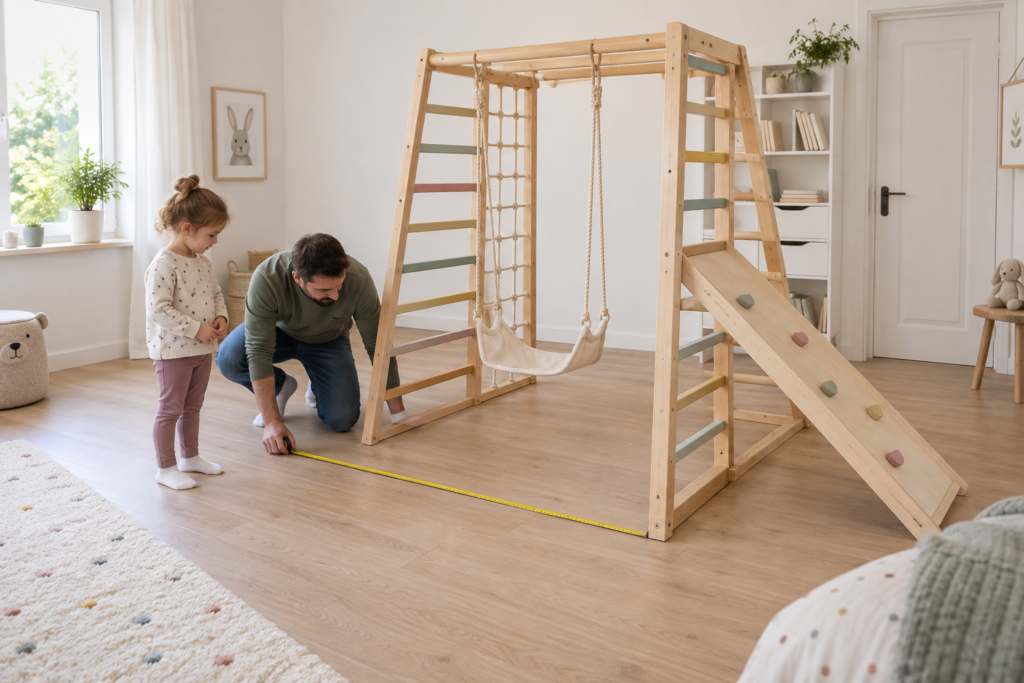
Alt text: Parent measures open floor space around a wooden indoor climbing frame while a child wearing socks watches.
Choose Materials Finishes and Colors with Purpose
Pine, birch and beech can all be used in children’s furniture, but they provide different combinations of weight, grain, hardness, price and production method.
The correct material depends on the structure, target price and customer market. One wood species is not automatically suitable for every design.
The Ciciwood guide to Pine vs Birch vs Beech for children’s furniture explains the main sourcing considerations in more detail.
Natural wood finishes work well in neutral children’s rooms and make the grain part of the product’s appearance. Muted rainbow rungs add visual contrast without overwhelming the surrounding interior.
For wholesale programs, beginning with one natural finish and one coordinated rainbow colorway can simplify:
- Product photography
- Inventory forecasting
- Carton identification
- Replacement-part management
- Online product selection
Material and environmental claims should be specific. If a product or package uses an FSC label, confirm that the certification scope and trademark authorization support the claim.
Refer to the official FSC label guidance when describing FSC-related materials or labels.
Make Safety Information Easy to Find
A strong product page should do more than show a beautiful children’s room.
It should clearly state:
- The exact model shown
- Intended age grade
- Permitted user count
- Stated load conditions
- Included accessories
- Required adult supervision
- Assembly requirements
- Installation and clearance guidance
- Applicable warnings
These details should remain consistent across the product page, packaging, instruction manual and warning labels.
For products sold in the United States, buyers should identify the CPSC requirements applying to the exact item. Applicable children’s products may require third-party testing and a Children’s Product Certificate.
The U.S. Consumer Product Safety Commission guidance explains the certificate framework.
For products sold in the European Union, buyers can consult the European Commission toy safety guidance and confirm the product-specific requirements with a qualified testing laboratory or compliance adviser.
A certificate name alone is not sufficient. Request documentation covering the exact SKU, material, coating, hardware and accessory combination being purchased.
Changes to dimensions, ropes, fasteners, finishes, swing seats or age grading may affect whether an existing report still covers the product.
A Practical Checklist for Retailers and Distributors
A consistent comparison sheet helps buyers evaluate complete products rather than relying only on attractive photographs.
Ask every supplier to provide the same information:
- Product code and complete configuration
- Included components and optional accessories
- Assembled product dimensions
- Complete in-use footprint
- Package dimensions and carton count
- Net and gross weight
- Carton volume and CBM
- Wood species and panel materials
- Coating and color system
- Age grade and stated load conditions
- Applicable reports and certificate references
- Assembly time and hardware list
- Spare-parts and replacement process
- MOQ by model or color
- Production lead time
- Private-label packaging options
Buyers can use the wooden furniture CBM calculation guide to compare assembled product dimensions with carton volume and container-loading requirements.
Why Buyers Work with Ciciwood
Ciciwood supports retailers, distributors and children’s brands with factory-direct wooden play furniture.
Our factory profile includes:
- 15 years of manufacturing experience
- More than 100 employees
- A 5,000-square-metre production facility
- Monthly capacity of more than 30,000 units
- OEM and ODM development
- Private-label packaging
- MOQ options generally ranging from 50 to 200 units
Buyers can explore the current Ciciwood product range, review an adjustable indoor wooden climbing gym set or learn more about our OEM and ODM development process.
Product documentation may include CPC, EN 71, CE and FSC-related materials or claims where applicable to the exact product and destination market.
For model recommendations, quotations and product-specific documentation, contact Ciciwood with your target country, sales channel, estimated quantity and preferred configuration.
अक्सर पूछे जाने वाले प्रश्न
What age is an indoor climbing frame with slide and swing suitable for?
There is no universal age range for every configuration. Follow the age grade provided for the exact model and consider the child’s abilities, approved setup and supervision instructions.
A higher climbing frame or swing attachment may have different requirements from a low beginner structure.
How much room does the complete set need?
Begin with the fully assembled dimensions and then include the ramp projection, swing movement and surrounding clearance required by the manufacturer.
Measure the actual room before ordering and keep the activity area away from doors, windows, furniture edges and busy walkways.
Can the ramp be used for both sliding and climbing?
Many wooden ramps are reversible. One side may be smooth for sliding, while the other includes steps or climbing holds.
This feature is model-specific. Confirm the approved orientations, attachment points and height settings in the product instructions.
Is a natural finish better than rainbow colors?
Both options can work.
Natural wood complements neutral interiors and highlights the material. Muted rainbow rungs create visual contrast and may make different hand and foot positions easier to identify.
Retailers can start with a limited palette and expand after reviewing customer demand.
Can the swing be removed?
Some models include a removable swing.
Removal and reinstallation should follow the supplied instructions. Confirm the approved suspension points, hardware, surrounding clearance and replacement-part policy before changing the setup.
Do all product versions use the same test report?
Not automatically.
Changes to the structure, material, coating, rope, hardware, accessories or age grade may affect the scope of testing and certification. Ask for documents that identify the exact SKU and variation being purchased.
What should a wholesale buyer include in an enquiry?
Provide the target country, sales channel, preferred model, estimated quantity, finish, accessories, branding requirements, required documentation and expected delivery date.
A complete enquiry allows the supplier to confirm MOQ, lead time, packaging, testing scope and quotation terms more accurately.
Final Takeaway
An indoor climbing frame with slide and swing works best when its activities feel connected, its total footprint is clearly understood and its safety information is easy to verify.
Choose the configuration according to the real room and intended user. Compare complete product information rather than accessory quantity alone, and confirm documentation for the exact SKU and destination market before sale.
Ready to plan a collection or request a sample? Contact Ciciwood for product recommendations, quotations and factory-direct support.