




What Is Montessori Education? Principles, Benefits, and Learning Through Play
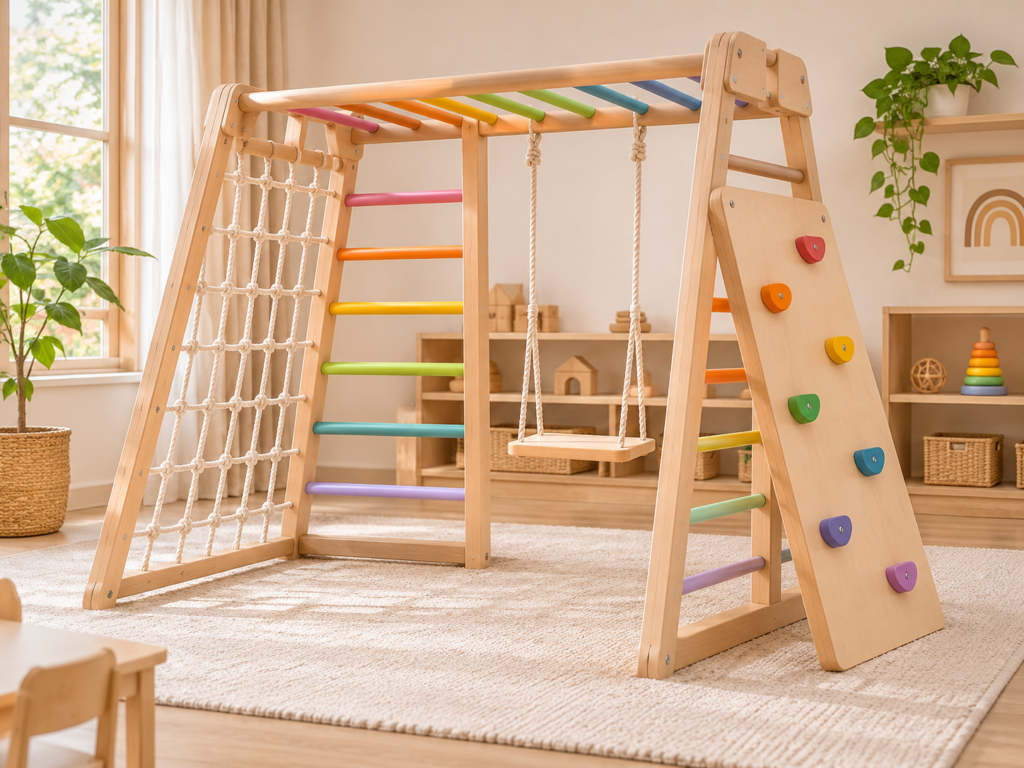
Montessori education is a child-centered approach to learning that encourages independence, curiosity, creativity, and hands-on exploration. Rather than asking children to follow the same learning path at the same pace, Montessori education recognizes that every child develops differently.
Today, Montessori-inspired learning has become increasingly popular among parents, preschools, kindergartens, and early childhood education professionals around the world.
From carefully organized learning spaces to simple wooden educational toys, the Montessori philosophy influences how children interact with their surroundings and develop important everyday skills.
But what exactly is Montessori education, and how can parents create an environment that supports this approach at home?
Let’s explore its core principles and discover how thoughtfully designed wooden toys and climbing equipment can support children’s development.
1. What Is Montessori Education?
Montessori education is an educational approach developed by Dr. Maria Montessori, an Italian physician and educator.
The approach is based on the idea that children learn naturally through exploration, observation, movement, and hands-on experiences.
Instead of relying entirely on traditional teacher-led instruction, Montessori environments encourage children to make choices, explore learning materials, and develop skills at their own pace.
Some important characteristics include:
- Child-centered learning
- Independence and self-directed activities
- Hands-on exploration
- Freedom within reasonable limits
- Respect for each child’s individual development
- A carefully prepared learning environment
The goal is not simply to teach children information. It is to help them develop the confidence, concentration, curiosity, and practical skills needed for lifelong learning.
2. Five Core Principles of Montessori Education
Understanding the main principles of Montessori education helps parents make better decisions when choosing toys, furniture, and learning activities for young children.
For more information about Montessori education, visit the American Montessori Society to learn more about its educational principles and teaching methods.
1. Independence
One of the most important Montessori principles is encouraging children to do things independently.
Simple everyday activities, such as choosing toys, organizing belongings, climbing safely, and helping with small household tasks, allow children to develop confidence.
Parents can support independence by providing child-sized furniture, accessible storage, and age-appropriate play equipment.
2. Learning Through Hands-On Experiences
Young children learn by interacting with the world around them.
Touching, building, sorting, moving, climbing, and experimenting give children opportunities to explore different concepts through direct experience.
Wooden building toys, stacking blocks, climbing frames, and practical life activities can encourage this type of active learning.
3. Freedom Within Limits
Montessori education encourages children to make choices while understanding appropriate boundaries.
Children may choose which activity to explore, how long to spend on it, and when to move on to something different.
However, freedom does not mean having no rules. A safe and supportive environment helps children explore while respecting reasonable limits.
4. Respect for Individual Development
Every child develops at a different pace.
Some children enjoy physical activities, while others prefer puzzles, drawing, building, or imaginative play.
A Montessori-inspired environment provides different opportunities for exploration without forcing every child to complete the same activity at the same time.
5. A Prepared Environment
The learning environment plays an important role in Montessori education.
A well-prepared space should be organized, accessible, comfortable, and appropriate for children’s developmental stages.
Low shelves, child-sized tables, wooden toys, reading corners, and designated activity areas help children interact with their surroundings more independently.

3. Benefits of Montessori-Inspired Learning for Young Children
Montessori-inspired activities can provide children with opportunities to develop a variety of important skills.
Independence and Confidence
When children are encouraged to make choices and complete simple activities independently, they have opportunities to build confidence and develop a sense of responsibility.
Problem-Solving Skills
Building structures, completing puzzles, and experimenting with different materials encourage children to explore solutions and learn through trial and error.
Concentration and Patience
Activities that involve sorting, stacking, building, or assembling can encourage children to focus on a task and complete it at their own pace.
Physical Coordination
Movement-based activities provide opportunities to develop balance, coordination, spatial awareness, and body control.
Creativity and Imagination
Open-ended toys allow children to explore different ways of playing instead of following only one fixed set of instructions.
These benefits depend on the child’s age, interests, developmental stage, and the quality of the learning environment.
4. Why Wooden Toys Are Popular in Montessori-Inspired Environments
Wooden toys are widely used in Montessori-inspired homes and educational spaces because of their simple designs, natural appearance, and versatility.
Unlike many electronic toys that provide predetermined sounds, lights, or instructions, open-ended wooden toys allow children to decide how they want to play.
Popular examples include:
- Wooden stacking blocks
- Wooden sorting toys
- Montessori learning towers
- เครื่องเล่นปีนป่ายทำจากไม้
- สามเหลี่ยมพิคล์
- Wooden activity tables and chairs
- Montessori storage shelves
These products can support different types of play, from creative building activities to everyday practical tasks.
When choosing wooden toys, parents should consider material quality, surface finishing, structural stability, age suitability, and applicable product safety requirements.
5. How Wooden Climbing Frames Support Active Learning
Montessori education recognizes the importance of movement and hands-on experiences in children’s development.
Wooden climbing frames provide opportunities for children to explore movement, balance, coordination, and spatial awareness through age-appropriate physical activities.
ตัวอย่างเช่น:
สามเหลี่ยมพิคล์
Pikler triangles provide climbing opportunities that children can explore at their own pace, with appropriate adult supervision.
Wooden Climbing Arches
Climbing arches can support different types of movement and imaginative play. Depending on their design, they may also be used as part of a play area or combined with suitable accessories.
Indoor Climbing Gyms
Multifunctional indoor climbing equipment can offer different physical play opportunities in one space.
These products are Montessori-inspired play equipment rather than traditional Montessori teaching materials. They can complement a child-centered environment by encouraging active exploration and independent movement.
Safety should always come first. Choose age-appropriate equipment, follow the manufacturer’s assembly and usage instructions, and provide suitable supervision.

6. How to Create a Montessori-Inspired Play Space at Home
Parents do not need an expensive classroom or a large room to create a Montessori-inspired environment.
A few thoughtful adjustments can make everyday spaces more accessible and engaging for young children.
Keep Toys Organized
Use low shelves and clearly defined storage areas so children can see, choose, and return their toys independently.
Choose Simple, Open-Ended Toys
Wooden blocks, stacking toys, puzzles, and climbing equipment provide different opportunities for exploration.
Create a Space for Movement
Leave enough room for age-appropriate physical activities. A suitable indoor climbing frame or soft play area can help children explore movement when outdoor play is not convenient.
Use Child-Sized Furniture
Low tables, small chairs, and accessible storage make it easier for children to participate in everyday activities.
Avoid Overcrowding the Space
A simple, organized environment allows children to focus on their chosen activities without unnecessary distractions.
The most important thing is to create a space that matches the child’s needs and encourages safe, meaningful exploration.
7. How to Choose Montessori-Inspired Wooden Toys
When purchasing wooden toys and climbing equipment, parents, retailers, and educational institutions should consider several important factors.
- Age suitability: Choose products designed for the child’s developmental stage.
- Material quality: Check the wood materials and surface finishes.
- Safety: Review structural stability, product design, and applicable safety standards.
- Functionality: Look for products that offer different opportunities for play and exploration.
- Space requirements: Consider the available indoor space and product dimensions.
- Durability: Choose well-constructed products suitable for regular use.
For retailers and distributors, product consistency, packaging, customization options, and reliable manufacturing support are also important considerations.
8. Discover Montessori-Inspired Wooden Products with CICIWOOD
At CICIWOOD, we focus on wooden indoor climbing frames, Pikler triangles, Montessori-inspired furniture, and children’s wooden play equipment.
We believe thoughtfully designed wooden products can create more opportunities for children to explore, move, play, and develop everyday skills.
Our product range includes:
- เครื่องเล่นปีนป่ายทำจากไม้
- Pikler triangles and climbing arches
- Montessori learning towers
- โต๊ะและเก้าอี้สำหรับเด็ก
- Montessori storage shelves
- Wooden play accessories
We also support B2B buyers with OEM and ODM customization, custom colors, logo branding, and wholesale product solutions.
Whether you are a children’s furniture retailer, toy distributor, preschool, or importer, CICIWOOD welcomes opportunities to discuss your product requirements.
Explore our Wooden Climbing Frame Collections, discover our OEM & ODM Services, or Contact CICIWOOD to learn more.

คำถามที่มักถูกถาม
1. What is the main idea of Montessori education?
The main idea is to support children’s natural development through independence, hands-on learning, exploration, and a carefully prepared environment.
2. What age is Montessori education suitable for?
Montessori education can be adapted for different stages of development, beginning in early childhood and continuing through adolescence.
3. Are wooden toys considered Montessori toys?
Not all wooden toys are Montessori materials. However, simple, open-ended wooden toys can complement Montessori-inspired learning when they encourage exploration, independence, and hands-on activities.
4. Are climbing frames part of Montessori education?
Indoor climbing frames are not traditional Montessori teaching materials. However, they can complement Montessori-inspired play environments by providing opportunities for movement, balance, and physical exploration.
5. How can parents create a Montessori environment at home?
Start with an organized space, accessible storage, child-sized furniture, simple toys, and opportunities for independent activities and safe movement.
ข้อคิดสุดท้าย
Montessori education is about more than choosing the right toys or decorating a child’s room in a particular style.
It is about creating an environment where children feel encouraged to explore, make choices, develop independence, and learn through everyday experiences.
From simple wooden toys to thoughtfully designed climbing equipment, the right play environment can give children more opportunities to discover their abilities and enjoy the process of growing.
At CICIWOOD, we are happy to support businesses and families looking for thoughtfully designed wooden products for children’s play and learning.