




















How to Calculate CBM for Wooden Kids Furniture Orders: A Practical Guide for Importers
Learn how to calculate CBM for wooden kids furniture, estimate container loading, compare packaging efficiency and plan cost-effective B2B import orders.When importing wooden kids furniture from overseas, the product price is only one part of the purchasing cost.
For bulky products such as wooden climbing frames, learning towers, kids tables and chairs, bookshelves, and indoor play furniture, shipping volume can have a significant impact on landed cost.
That is why understanding wooden furniture CBM calculation is important for importers, distributors, wholesalers, and private-label brands.
A product with a slightly lower factory price is not always the more economical option. If its packaging occupies significantly more container space, the total logistics cost per unit may actually be higher.
This guide explains how to calculate CBM, estimate container loading quantities, compare packaging efficiency, and use volume data when planning wooden kids furniture orders.
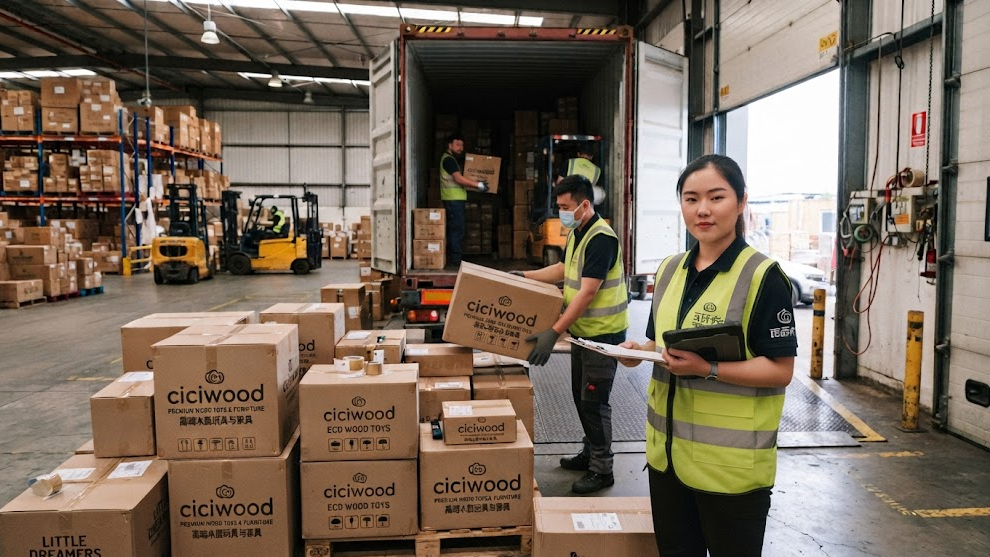
1. What Does CBM Mean?
CBM stands for cubic meter.
It measures the volume occupied by a carton, pallet, crate, or shipment.
For international furniture shipments, CBM is commonly used when estimating:
- Shipping volume
- Container utilization
- LCL freight
- Warehouse space
- Loading quantities
- Logistics cost per unit
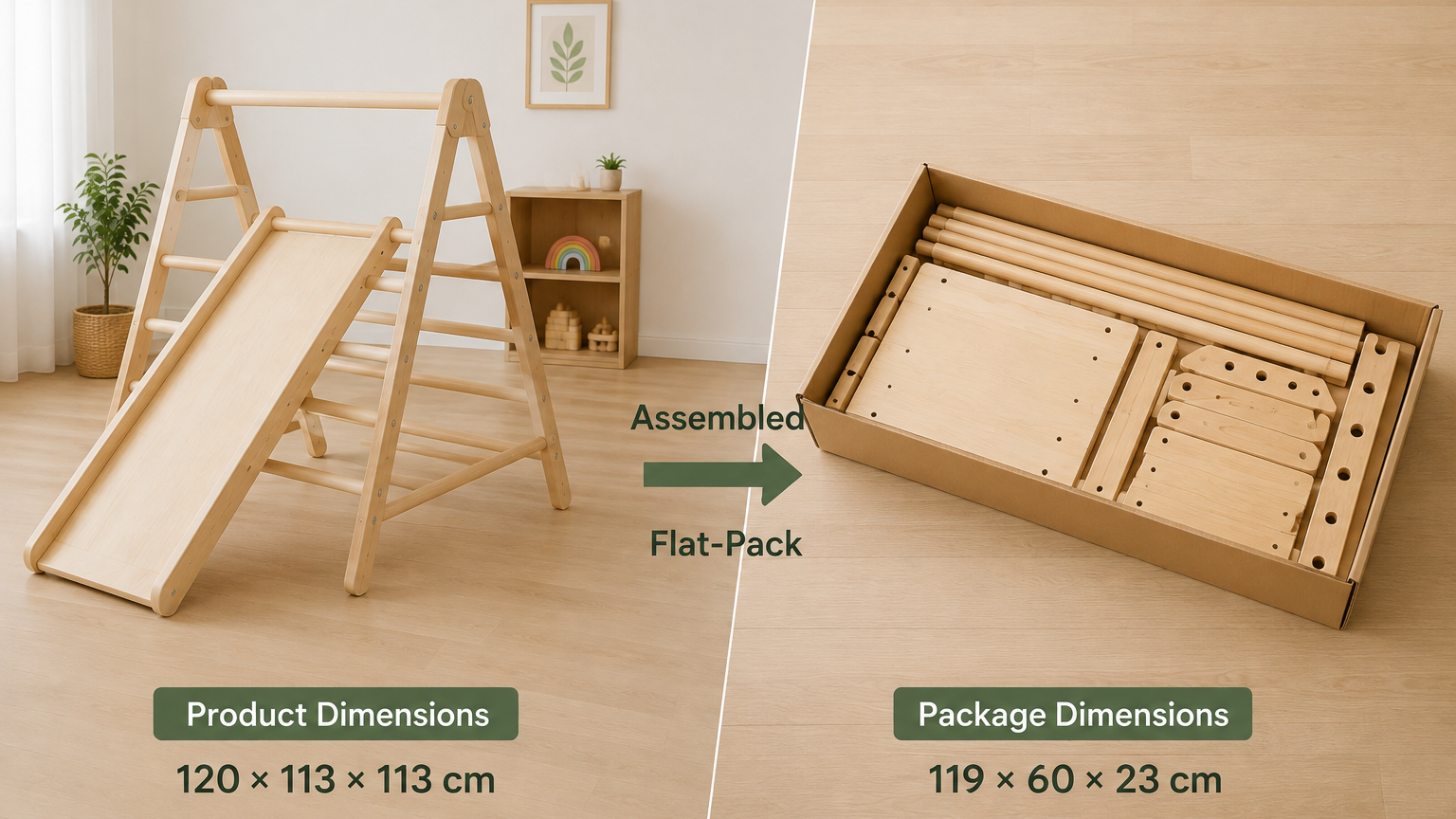
For wooden children’s furniture, the CBM should normally be calculated from the packed carton dimensions, rather than the assembled product dimensions.
This distinction is important.
A large climbing frame may look bulky when assembled but can occupy much less shipping space when designed for flat-pack transportation.
2. The Basic CBM Formula
If the carton dimensions are measured in meters, the formula is:
Length × Width × Height = CBM
For example, suppose one carton measures:
1.20 m × 0.60 m × 0.20 m
The calculation is:
1.20 × 0.60 × 0.20 = 0.144 CBM
Therefore, one carton occupies approximately:
0.144 m³
If your supplier provides carton dimensions in centimeters, you can calculate CBM using:
Length (cm) × Width (cm) × Height (cm) ÷ 1,000,000
For example:
120 × 60 × 20 ÷ 1,000,000 = 0.144 CBM
This simple calculation becomes very useful when comparing several products.
3. Product Dimensions and Package Dimensions Are Not the Same
One common mistake is using the assembled product dimensions to estimate shipping volume.
For furniture imports, always distinguish between:
Product Dimensions
and
Package Dimensions
Imagine an assembled climbing frame measuring approximately:
120 × 113 × 113 cm
This does not mean the shipment occupies that entire volume.
If the product can be disassembled and flat-packed, the carton might be approximately:
119 × 60 × 23 cm
The resulting shipping volume is dramatically smaller than the assembled volume.
This is one reason why packaging engineering matters so much for wooden furniture.
4. Why Flat-Pack Design Matters for B2B Buyers
Flat-pack design is not only about making a product easier to ship.
It can influence the economics of the entire product.
An efficient flat-pack structure may help:
- Reduce carton volume
- Increase units per container
- Reduce freight cost per unit
- Improve warehouse efficiency
- Simplify distribution
- Reduce empty space inside cartons
For e-commerce retailers, carton dimensions can also affect downstream fulfillment and last-mile shipping.
Therefore, packaging efficiency should be evaluated during product sourcing—not after the purchase order has already been confirmed.
5. Compare Products by Shipping Volume, Not Only Unit Price
Consider two similar wooden climbing products.
Supplier A offers a slightly lower unit price.
Supplier B is slightly more expensive.
At first glance, Supplier A appears more competitive.
But imagine Supplier B has redesigned the product for more efficient flat-pack packaging.
If Supplier B’s carton is significantly smaller, more units may fit into the same container.
The difference in freight cost per unit could partially or completely offset the difference in factory price.
This is why experienced buyers compare:
Product Cost + Packaging Efficiency + Freight + Destination Costs
rather than comparing only the EXW or FOB product price.
6. How to Estimate Container Loading Quantity
Once you know the CBM per carton, you can make a rough estimate of how many units may fit into a container.
The basic calculation is:
Usable Container Volume ÷ CBM per Carton = Estimated Quantity
However, this number should only be treated as an initial estimate.
Real container loading is affected by:
- Carton dimensions
- Carton orientation
- Container internal dimensions
- Unusable gaps
- Mixed SKUs
- Weight limits
- Loading method
- Pallets, if used
In other words:
Theoretical CBM capacity is not the same as actual loading capacity.
A supplier should ideally confirm loading quantities using the actual carton specifications.
7. 20GP, 40GP and 40HQ: What Is the Difference?
Three common container types used in furniture importing are:
20GP
A standard 20-foot general-purpose container.
40GP
A standard 40-foot general-purpose container with considerably more loading space.
40HQ
A 40-foot high-cube container with additional internal height.
For bulky but relatively lightweight products such as certain flat-packed wooden kids furniture, volume may become the limiting factor before maximum container weight is reached.
That is why 40HQ containers are commonly considered for volume-sensitive furniture shipments.
However, buyers should always confirm current container specifications and loading plans with their freight forwarder or shipping partner.
8. Don’t Simply Divide Container CBM by Product CBM
This is an important purchasing detail.
Suppose your theoretical calculation suggests that a container has enough volume for 400 cartons.
That does not automatically mean 400 cartons will physically fit.
Why?
Because cartons are rectangular objects with fixed dimensions.
Small gaps can appear between cartons, around container doors, near the ceiling, or between differently sized products.
This is known as space utilization.
For this reason, actual loading plans are more reliable than theoretical CBM calculations.
For larger orders, ask the manufacturer for:
- Carton dimensions
- CBM per carton
- Gross weight
- Net weight
- Units per carton
- Estimated container quantity
- Loading photos from similar orders, where available
These details give buyers a more realistic picture of shipping efficiency.
9. Mixed-SKU Orders Require More Careful Planning
Many distributors do not want an entire container of one product.
They may want to combine:
- Climbing frames
- Slides
- หอการเรียนรู้
- Tables
- Chairs
- Bookshelves
- เฟอร์นิเจอร์เก็บของ
This creates a mixed-SKU container.
Mixed loading can help retailers test more products and create a broader collection, but it also makes container planning more complicated.
Different carton sizes need to be arranged efficiently.
For example, long climbing-frame cartons may occupy the main loading area while smaller accessory cartons can potentially use remaining spaces more efficiently.
A good mixed-container plan considers the entire order rather than calculating each SKU independently.
10. Calculate CBM Before Confirming Your Product Mix
If you are preparing a trial order, request packaging data before finalizing quantities.
Imagine you want to order four products.
Instead of immediately purchasing 100 units of each, calculate the total CBM first.
You may discover that one oversized product consumes a disproportionate amount of container space.
You can then adjust the order.
For example:
Reduce the quantity of the bulky SKU.
Increase the quantity of compact best sellers.
Use smaller accessories to balance remaining space.
This can create a more efficient trial shipment.
11. Accessories Also Affect Container Efficiency
Accessories should not be ignored during CBM planning.
A long slide board may occupy considerable carton length even though it is relatively thin.
A hammock may occupy very little space.
A swing may fit inside the main product carton.
A separate climbing ramp may require another large flat carton.
Therefore, two product bundles that look similar online may have very different shipping volumes.
Before creating a bundle, B2B buyers should ask:
Can the accessory fit inside the main carton?
If yes, the bundle may be much more logistics-efficient.
If not, adding the accessory could create another carton and increase the shipment volume significantly.
12. Packaging Engineering Can Improve Profit Margins
Packaging is often treated as something that happens after product development.
For international furniture businesses, it should be considered much earlier.
Small reductions in carton dimensions can become meaningful when multiplied across hundreds or thousands of units.
For example, reducing unnecessary empty space may allow additional units to fit into each container.
Over multiple shipments, this can improve logistics efficiency and potentially reduce landed cost per unit.
Good packaging engineering should balance:
Compact Size
with
Adequate Product Protection
Reducing carton volume is not useful if the packaging becomes too weak and causes transportation damage.
13. Don’t Sacrifice Protection Just to Reduce CBM
The smallest possible carton is not always the best carton.
Wooden children’s furniture may contain:
- Long wooden components
- Finished surfaces
- Rounded corners
- Hardware
- Panels
- Rungs
- Accessories
These components need appropriate protection during international transportation.
Packaging may require:
- Protective foam
- Corner protection
- Inner cartons
- Separators
- Hardware bags
- Protective wrapping
- Strong outer cartons
The objective is not simply:
Minimum CBM
It is:
Efficient CBM + Adequate Protection
Both factors affect the real landed cost.
14. Calculate the Total CBM of Your Purchase Order
Once you know the CBM of each SKU, calculating the approximate total shipment volume becomes straightforward.
For each product:
CBM per Carton × Number of Cartons
Then add the results together.
For example:
Product A total volume
+
Product B total volume
+
Product C total volume
+
Accessory cartons
Estimated Total Shipment CBM
This gives you a useful starting point when discussing freight options with your forwarder.
15. Use CBM to Compare Quotations More Accurately
When comparing suppliers, consider requesting the following information for every product:
Unit Price
Product Dimensions
Carton Dimensions
CBM
Gross Weight
Packing Method
Estimated Loading Quantity
Two quotations may look similar until this information is compared.
A product with a competitive factory price but inefficient packaging may become less attractive after freight is included.
This is particularly important for wooden kids furniture because many products are relatively bulky compared with their selling price.
16. CBM Also Matters for LCL Shipments
Not every order requires a full container.
Smaller trial orders may be shipped by LCL—Less than Container Load.
In these shipments, freight calculations can depend heavily on cargo volume and other shipping rules.
This makes accurate carton measurements especially important.
If you are planning a sample order or small wholesale shipment, ask the supplier for the packed dimensions and gross weight before requesting a freight quotation.
This allows your logistics provider to estimate shipping costs more accurately.
17. A Practical CBM Checklist for B2B Buyers
Before confirming a wooden kids furniture order, make sure you know:
What are the assembled product dimensions?
What are the carton dimensions?
How many cartons does each product use?
What is the CBM per unit?
What is the gross weight?
Can accessories fit inside the main carton?
What is the estimated 20GP / 40GP / 40HQ loading quantity?
Is the order single-SKU or mixed-SKU?
Is palletization required?
Has the supplier loaded similar products before?
These questions can prevent surprises after production is completed.
18. Think in Landed Cost, Not Factory Price
Ultimately, CBM calculation is part of a larger purchasing principle.
A professional importer should evaluate the landed economics of a product.
The cheapest factory quotation is not necessarily the product with the best commercial potential.
A more complete evaluation considers:
Factory Price
บรรจุภัณฑ์
International Freight
Import-Related Costs
Warehousing
Fulfillment
Potential Damage and Returns
For bulky wooden products, shipping efficiency can influence several of these costs.
That makes CBM an important purchasing metric—not simply a logistics abbreviation.
Final Thoughts
Understanding wooden furniture CBM calculation helps B2B buyers make better decisions before placing an order.
The process starts with a simple formula:
Length × Width × Height = CBM
But professional purchasing goes further.
Importers should compare carton efficiency, product configurations, accessory packaging, mixed-SKU loading, container utilization, and overall landed cost.
For wooden kids furniture, an effective strategy is:
Check Package Dimensions
↓
Calculate CBM
↓
Compare Packaging Efficiency
↓
Plan SKU Quantities
↓
Estimate Container Loading
↓
Confirm With the Manufacturer
↓
Request Freight Quotations
The goal is not simply to fit more products into a container.
It is to find the right balance between product protection, shipping efficiency, inventory strategy, and landed cost.
Planning a Wooden Kids Furniture Order?
CiciWood works with international retailers, importers, distributors, wholesalers, and private-label brands on wooden children’s furniture and indoor play products.
For B2B orders, product information can include packaging dimensions, carton volume, loading quantities, product configurations, and customization requirements to support purchasing and shipping planning.
Our product categories include wooden climbing frames, learning towers, kids tables and chairs, bookshelves, storage furniture, and related wooden play products.
We also support OEM และ ODM development, private-label branding, custom packaging, product configurations, and bulk manufacturing.
If you are planning an order, send us your product list, target quantity, destination market, and preferred configurations so the appropriate packing and order details can be evaluated.