




















How to Compare Wooden Climbing Frames: 9 Things to Check Before Buying
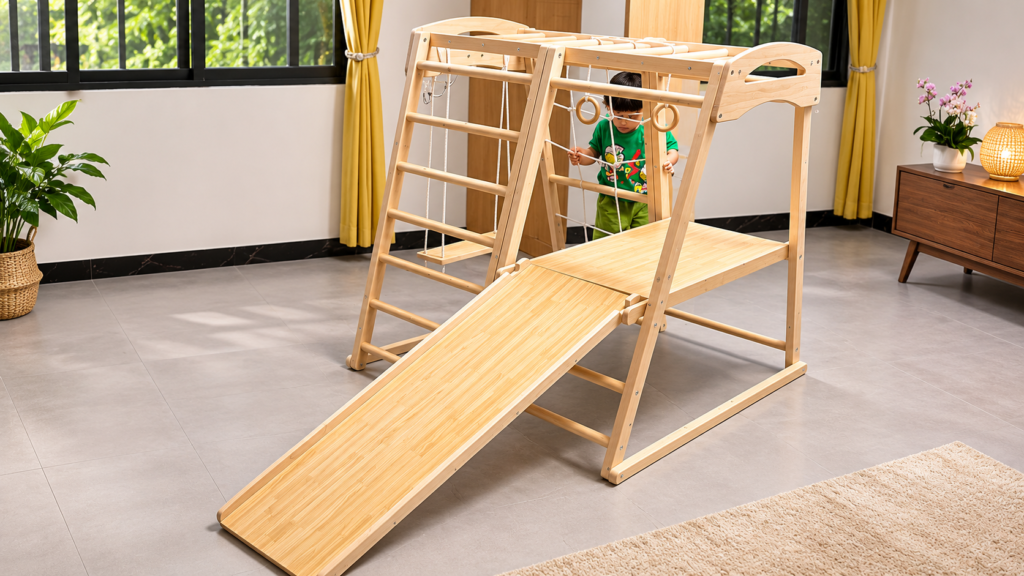
Choosing the right wooden climbing frames for children involves more than comparing appearance and price. Buyers should also consider wood quality, structural stability, surface finish, safety requirements, and everyday usability.
Whether you’re a parent buying an indoor playset or a retailer sourcing wooden climbing equipment, knowing what to check can help you avoid expensive mistakes.
1. Don’t Judge a Climbing Frame by Appearance Alone
A nice design doesn’t mean a well-made product. Some climbing frames look almost identical on a product page, but the construction underneath can be very different.
Before you choose, look at the overall frame structure and support points, the thickness and quality of the wooden components, how ladders connect to side panels and crossbars, whether the frame stays stable during normal use, and whether the assembly instructions are clear.
Ask the supplier for close-up photos of joints, screws, support points, and the assembled product. Those tell you far more than a front-view shot ever will.
When comparing wooden climbing frames, always look beyond the product photos and examine the actual construction details.
2. Check the Wood and Surface Finish

Wood quality is one of the first things to examine. Products may use different wood species, plywood, or combinations, and no single wood type automatically makes every climbing frame better. Instead of relying on material names, look at the finished product.
Check for smoothly sanded surfaces, rounded corners and edges, no visible splinters or loose fibers, consistent finishing across components, and no obvious cracks or damage. A good surface finish matters for both appearance and everyday handling.
Request close-up photos of corners, edges, and frequently touched areas. If possible, get a physical sample before placing a large order.
When selecting wooden climbing frames, buyers should always consider the quality of the materials and the details of the construction.
3. Stability Matters More Than Extra Features
Some climbing frames come with ladders, slides, rope nets, swings, and climbing walls. More activities make a product look attractive, but each feature adds joints, attachments, and structural details you now have to evaluate.
Check whether the base provides enough support, whether the frame stands evenly on a level floor, whether connecting parts fit securely, whether locking mechanisms work correctly, and whether accessories are compatible with that specific model.
Don’t assume a heavier product is automatically safer. A real evaluation looks at the complete structure, intended use, relevant testing, and manufacturer instructions.
Well-designed wooden climbing frames should combine practical features with a stable structure and suitable installation requirements.
4. Compare Age Recommendations and Product Dimensions
A climbing frame should match a child’s development and physical ability. A product designed for toddlers may not suit older children, and a taller structure may be too challenging for younger users.
Before buying, compare the recommended age range, the maximum user weight specified by the manufacturer, overall height, width, and length, ladder spacing and climbing difficulty, and available play space around the equipment.
Age recommendations are not a substitute for supervision or an assessment of a child’s individual abilities. Measure the room before ordering, leave enough space around the frame for movement, and follow the manufacturer’s installation and clearance instructions.
5. Don’t Choose Based on the Number of Accessories
A big accessory package looks like better value, but not every accessory is equally useful. A reversible ramp gives you both climbing and sliding. A rope net offers a different climbing experience from a traditional ladder. A swing adds another activity but needs proper installation and clearance. A foldable design helps families with limited storage.
Instead of counting accessories, think about how each feature contributes to the product’s intended use. A simpler climbing frame with a practical design often beats a complicated set with features that rarely get used.
6. Check Safety Information and Relevant Standards
This is one of the most important steps when buying children’s wooden play equipment. Don’t rely only on a supplier saying a product is safe or certified. Ask for documentation that applies to the exact model and target market.
For buyers in the United States, the Consumer Product Safety Commission (CPSC) provides guidance on playground equipment and children’s toy safety. For products classified as children’s toys, applicable requirements may include ASTM F963 under 16 CFR Part 1250. For the European market, toy products placed on the market must meet applicable toy safety requirements and carry the required CE marking.
Useful official resources:
- CPSC – Playground Equipment Guidance
- CPSC – Toy Safety Business Guidance
- European Commission – Placing Toys on the EU Market
Ask which standards apply to your particular product, what tests have been completed, and whether the supporting documents match the model you intend to buy. A certificate for one model is not proof that every product in a collection has the same certification.
7. Compare Foldable and Fixed Designs
Another common mistake is choosing a product without thinking about how it will actually be used at home. Fixed climbing frames can provide a more permanent play area, while foldable models are useful where storage space is limited.
| Feature | Fixed Design | Foldable Design |
|---|---|---|
| Storage | Requires dedicated space | Easier to store |
| Setup | Usually stays assembled | Requires folding and unfolding |
| Daily use | Convenient for permanent play areas | Flexible for smaller homes |
| Inspection | Check fixed joints | Also inspect locking mechanisms |
For foldable products, pay particular attention to hinges, locking systems, and instructions for safe assembly and storage.
8. Evaluate the Supplier, Not Just the Product
For retailers, importers, and distributors, product quality is only one part of a successful purchase. A reliable supplier should be able to explain the product specifications and provide clear information before an order is confirmed.
Worth asking: What materials are used? What are the assembled and packed dimensions? What is the manufacturer’s specified load limit? Which test reports or certificates are available for this model? Can the product be customized? Are replacement parts available? What are the MOQ and production lead time? Can the supplier provide real production and packaging photos?
For private-label buyers, also discuss logo placement, packaging design, instruction manuals, and carton protection. Clear communication before production prevents misunderstandings later.
9. Don’t Ignore Packaging and After-Sales Support
Even a well-made climbing frame can arrive with damaged components if the packaging is inadequate. Before confirming an order, review individual component protection, corner and edge protection, hardware packaging and labeling, assembly instructions, spare parts arrangements, and carton dimensions and shipping weight.
For international buyers, packaging matters even more because products travel through several stages of transportation and handling. A supplier who pays attention to packaging details helps reduce avoidable delivery problems.
A Practical Wooden Climbing Frame Buying Checklist
Before you make a final decision, run through this checklist:
| What to Check | Questions to Ask |
|---|---|
| Materialien | Is the material clearly specified? |
| Surface finish | Are edges smooth and free from splinters? |
| Aufbau | Are joints and connections secure? |
| Stability | Does the design suit its intended use? |
| Age range | Is the recommended age clearly stated? |
| Dimensions | Does it fit the available space? |
| Zubehör | Are all attachments compatible? |
| Safety documents | Do the documents match the exact model? |
| Verpackung | Are components properly protected? |
| Supplier | Can the supplier provide clear product information? |
The best product isn’t the one with the most accessories or the lowest price. It’s the one that meets the intended requirements, has clearly documented specifications, and offers dependable quality.
Explore Wooden Climbing Frames with CICIWOOD
At CICIWOOD, we focus on wooden children’s play products, including indoor climbing frames, Pikler triangles, climbing ramps, and multifunctional playsets. International buyers need more than attractive product photos. They need clear specifications, practical customization options, suitable product documentation, and reliable communication.
Our team supports B2B buyers with wooden climbing frame collections, OEM and ODM customization, custom colors, logos, and packaging, product specification discussions, and wholesale and private-label cooperation.
Explore our Wooden Climbing Frames & Gyms Collection to see available product styles, or browse our Pikler Triangles & Ramps Sammlung.
Looking for a wooden climbing frame supplier?
Visit CICIWOOD and contact our team to discuss your product requirements, target market, and wholesale plans.
Häufig gestellte Fragen
1. What should I check first when buying a wooden climbing frame?
Start with the structure, stability, surface finish, product dimensions, and safety documentation. These matter more than appearance alone.
2. Are foldable wooden climbing frames a good choice?
They can be useful for homes with limited storage space. Buyers should still inspect the hinges, locking mechanisms, and folding instructions carefully.
3. Is a more expensive climbing frame always better?
Not necessarily. Compare materials, construction, testing, specifications, and after-sales support rather than relying on price alone.
4. What should importers ask a wooden climbing frame manufacturer?
Ask about materials, product dimensions, load limits, relevant testing documents, MOQ, packaging, customization, and production lead time.
5. Can wooden climbing frames be customized for private-label brands?
Customization may include colors, product configurations, logos, packaging, and instruction manuals, depending on the product model and the manufacturer’s capabilities.
CICIWOOD – Play. Learn. Grow Naturally.