


















Pine vs Birch vs Beech: The Complete Wood Selection Guide for Children’s Furniture
Pine vs birch vs beech comparison for children’s furniture. Learn how material selection impacts cost, safety, and supply chain for B2B buyers.
For cross-border e-commerce brands, educational distributors, and commercial importers, selecting the right raw material is one of the most foundational decisions in product engineering. In the wooden children’s furniture sector—particularly for Montessori play structures, Pikler climbing triangles, balance boards, and learning towers—three primary timber types dominate factory production: Solid Pine, Birch Plywood, and Solid Beech.
Choosing the optimal wood species is rarely a simple choice of finding the “highest quality” timber. Instead, successful B2B buyers must strategically balance structural load performance, tactile smoothness, shipping weight, factory lead times, target retail price points, and landed profit margins.
Here is an in-depth, objective analysis comparing Pine, Birch Plywood, and Beech wood to help wholesale importers build a resilient and high-margin product catalog.
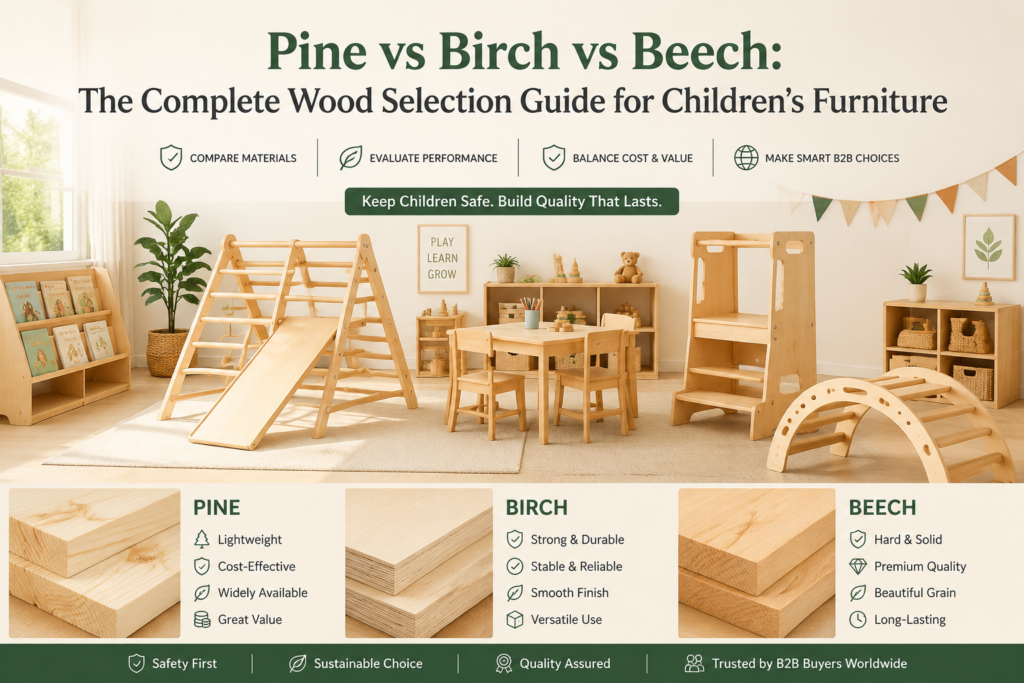
1. Material Characteristic & Performance Comparison
pine vs birch vs beech
Understanding the underlying physical metrics of each timber type allows product managers and sourcing agents to match raw materials with specific structural components.
───────────────────────────────────────────────────────────────────────────
                       Comprehensive Timber Metric Matrix
─────────────────────────────────────────────────────────────────────                                       Metric / Property  │ Solid Pine       │ Birch Plywood     │ Solid Beech
─────────────────────────────────────────────────────────────────────────
 Janka Hardness     │ ~380 - 420 lbf  │ ~1,200+ lbf       │ ~1,300 - 1,45lb
 Density (Dry)      │ ~420 - 500 kg/m³│ ~680 - 720 kg/m³  │ ~710 - 750 kg/m
 Dimensional Stability│ Moderate      │ Superior (Cross)  │ Modera(Moisture
 Grain / Texture    │ Visible Knots   │ Clean Multi-Layer │ Fine, Even Grai
 Raw Material Cost  │ Budget ($)      │ Mid-Range ($$)    │ Premium ($$$)
────────────────────┴─────────────────┴───────────────────┴─────────────────
2. Solid Pine Wood: Cost-Efficiency & Scandinavian Aesthetic
pine vs birch vs beech
Solid pine is widely used across residential children’s furniture and lighter indoor play equipment. It features a prominent natural grain pattern with characteristic knots, imparting a classic, warm Scandinavian aesthetic.
Advantages for B2B Importers
- Cost Efficiency: Lower raw timber acquisition costs allow e-commerce sellers to achieve competitive retail price points while maintaining healthy margins.
- Lightweight Advantage: Lower physical density significantly decreases package gross weight, reducing ocean freight costs per unit and lowering last-mile parcel charges (FedEx/UPS/DHL).
- Workability: Pine is easy to cut, drill, and shape, leading to higher manufacturing throughput and faster production turnaround times.
Key Considerations & Drawbacks
- Softness & Dents: As a softwood, pine is more susceptible to surface indentation or scratches under heavy mechanical impact.
- Knot Stability: Natural wood knots must be properly inspected and filled during factory processing to prevent structural weaknesses near load-bearing joinery.
Recommended Product Applications
- Single folding climbing triangles, children’s storage frames, low bookshelf units, lightweight activity tables, and residential bedroom sets.
3. Birch Plywood: Superior Structural Stability & Modern Design
Multi-layer birch plywood has become an industry standard in modern European and North American Montessori furniture due to its distinctive cross-laminated aesthetic edge profile and exceptional structural strength.
Advantages for B2B Importers
- Dimensional Stability: The alternating cross-laminated wood veneers prevent panels from warping, twisting, or expanding when exposed to humidity changes during long ocean voyages.
- High Fastener Retention: Holds barrel nuts, threaded inserts, and assembly screws extremely tightly without risk of splitting along timber grain lines.
- High Load Capacity: Offers incredible flexural strength, making it ideal for large flat panels that support active child weights.
Key Considerations & Drawbacks
- Formaldehyde Emission Compliance: Importers must ensure the factory uses eco-friendly, low-emission glues that comply strictly with CARB Phase 2 and EPA TSCA Title VI standards.
- Precision CNC Machining: Requires sharp tooling and precise sanding protocols to ensure smooth, splinter-free exposed multi-layer edges.
Recommended Product Applications
- Load-bearing side frames for climbing gyms, slide and ramp boards, curved balance boards, Montessori activity cubes, and modular playroom dividers.
4. Solid Beech Wood: Premium Durability for Heavy Load Rungs
pine vs birch vs beech
Beech is a dense, fine-grained hardwood widely recognized for its high shock resistance, smooth tactile feel after polishing, and premium structural reliability.
Advantages for B2B Importers
- Maximum Mechanical Strength: Resists intense bending stresses and heavy impact, making it ideal for commercial early learning environments.
- Splinter-Free Finish: Extremely tight grain structure allows factory technicians to sand components to a silky-smooth finish that absorbs clear lacquers evenly.
- Commercial Longevity: Products manufactured with solid beech hold up exceptionally well under daily use in preschools, daycare centers, and public play spaces.
Key Considerations & Drawbacks
- Higher Landed Costs: Premium raw material pricing combined with heavier unit weight increases overall ocean freight and delivery costs.
- Moisture Sensitivity: Unfinished beech can react to drastic humidity fluctuations if kiln drying ($8\% – 12\%$ target moisture content) is not strictly enforced during production.
Recommended Product Applications
- Solid climbing ladder rungs, load-bearing structural pegs, heavy-duty commercial learning towers, daycare chairs, and premium play gyms.
5. The Hybrid Material Strategy: Optimizing Cost & Strength
Leading children’s furniture manufacturers rarely rely on a single wood type for complex play structures. Instead, an engineered Hybrid Material Strategy optimizes product safety while preserving wholesale price competitiveness.
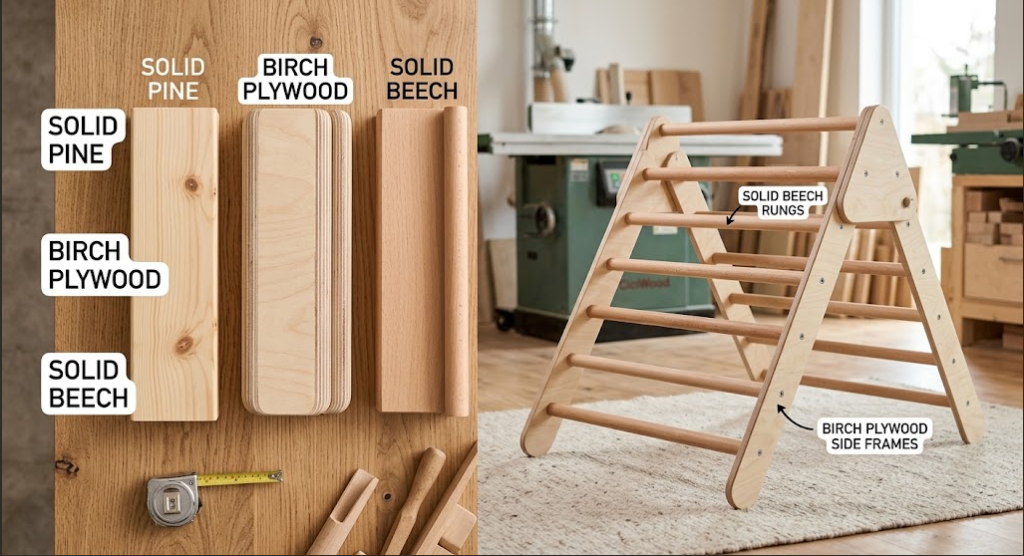
- Hybrid Climbing Gym Example: Utilizing Birch Plywood for large flat side panels (maximizing structural stability and lowering waste), paired with Solid Beech Rungs (ensuring maximum load-bearing safety where children step), and Pine Accent Components for non-structural accessories.
- Financial Impact: A hybrid design reduces overall raw material expenses by $15\% – 25\%$ compared to an all-beech structure while maintaining identical weight capacity ratings.
6. Regulatory Compliance & Surface Finishing Standards
pine vs birch vs beech
Regardless of the timber selected, all finished products imported into major global markets must satisfy stringent chemical, environmental, and mechanical safety codes.
- Chemical Coating Safety: All lacquers, stains, and clear oil finishes must be non-toxic, water-based, and verified compliant with CPSIA total lead limits ($<90\text{ ppm}$) and European EN71-3 Heavy Metal Migration safety standards.
- Moisture Content Audit: Raw timber must undergo controlled kiln-drying to achieve an internal moisture content of $8\% – 12\%$. This prevents wood warping, surface cracking, or mold development during tropical ocean transport.
💡 Summary: Material Selection Guide for Buyers
pine vs birch vs beech
- Choose Pine if your primary objective is entering budget-conscious consumer markets with lightweight, cost-effective residential products.
- Choose Birch Plywood if you are building modern Montessori e-commerce lines requiring sleek flat-pack (KD) panels, zero warping, and high aesthetic appeal.
- Choose Beech Wood if you are targeting premium retail segments or commercial daycare distributors where maximum durability is mandatory.
- Choose a Hybrid Design to achieve the ultimate balance between structural load safety and landed cost efficiency.
To request material sample kits, custom wood spec sheets, or structural engineering consultations for your private-label line, [Contact Our Technical Engineering Team] today.